
















With the development of industries such as AI servers, automotive electronics, 5G communications, and advanced packaging, high-end electronic materials are evolving toward finer particle sizes, higher purity, more uniform dispersion, and greater batch-to-batch consistency.
In MLCC electronic ceramics, materials such as barium titanate and nickel paste require strict control over particle size, agglomeration, dispersion uniformity, and impurity contamination. In the field of semiconductor materials, CMP (chemical mechanical polishing) slurries, certain photoresist-related nano-dispersion systems, electronic pastes, and functional materials also place higher demands on nano-grinding and fine dispersion.
The core challenges center on: agglomeration control, particle size distribution, low contamination, slurry stability, and process scale-up.
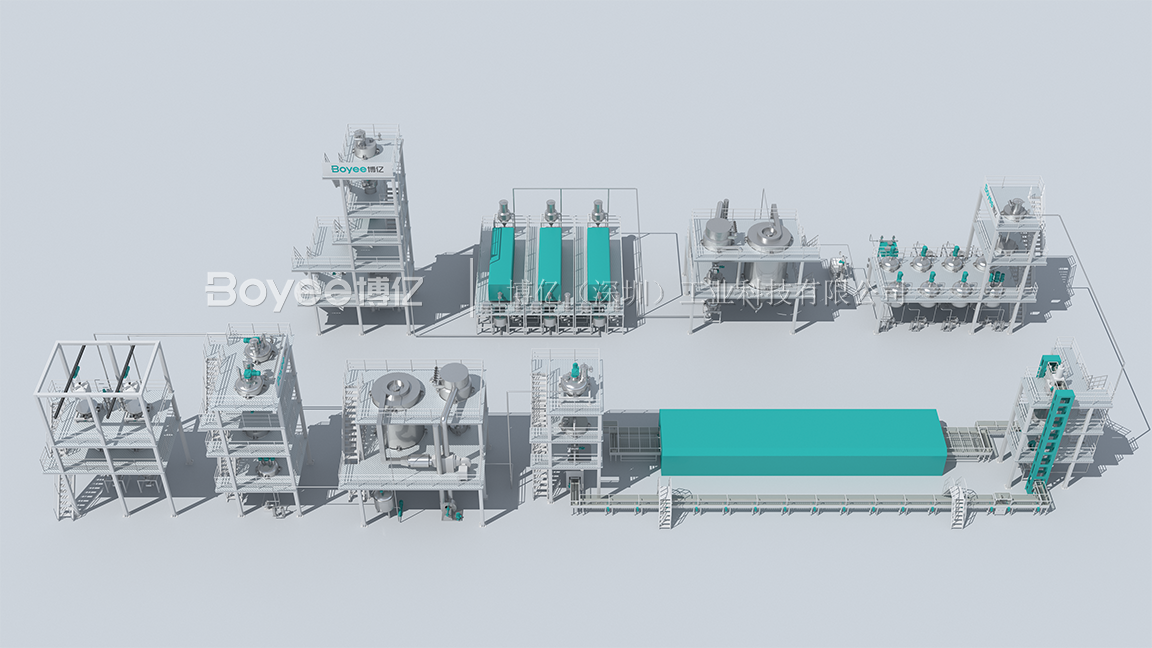
Pictured: Boyee Industrial's MLCC Electronic Ceramic Materials Production Line Solution
1. MLCC Electronic Ceramics: Grinding Is More Than Just “Grinding Fine”
As MLCCs evolve toward miniaturization, high capacitance, and multilayer structures, dielectric layers are becoming increasingly thin, leading to continuously rising demands for consistency in electronic ceramic powders such as barium titanate.
During the grinding process, attention must be paid not only to particle size but also to: particle refinement, agglomeration and deagglomeration, particle size distribution, low contamination, crystal structure protection, and dispersion stability.
Insufficient grinding may result in the presence of coarse particles and residual agglomerates; excessive grinding, on the other hand, may lead to structural damage, temperature rise, and impurity contamination. Therefore, the manufacture of MLCC electronic ceramics requires a stable nano-grinding process window.
2. From Barium Titanate to Nickel Paste: Dispersion Uniformity Determines Subsequent Stability
MLCCs consist of alternating layers of dielectric ceramic and internal electrode layers. As the number of layers increases and the dielectric layers become thinner, both barium titanate powder and nickel paste require more stable particle size distributions and dispersion states.
Common requirements for equipment used with these materials include: low contamination, low residue, stable temperature control, compatibility with fine particles, and batch consistency.
Consequently, the production of high-end electronic materials is gradually shifting from a single bead mill to an integrated production line model that combines mixing, dispersion, nano-grinding, conveying, and automated control.
3. Semiconductor Materials Also Require Precise Dispersion and Particle Control
1) CMP (Chemical Mechanical Polishing) Slurries
Nano-sized abrasive particles in CMP slurries—such as silicon dioxide, cerium oxide, and aluminum oxide—require careful control of the following factors: large particles, agglomeration, particle size distribution, slurry stability, and impurity contamination.
Therefore, the manufacture of CMP slurries is, in essence, a typical nanoparticle grinding and dispersion process.
2) Photoresist-Related Nanodispersion Systems
Certain photoresist-related materials and functional coating systems containing inorganic nanoparticles, pigments, or functional fillers also require solutions to address agglomeration, uniform dispersion, and low contamination. For these materials, the focus cannot be solely on “fineness”; they must also balance purity, stability, uniformity, and control of cleaning residues.
3) Electronic Pastes and Functional Materials
For conductive pastes, ceramic pastes, and other functional materials, the common process can be summarized as: powder → wetting → dispersion → nano-grinding → filtration → storage and delivery.
The core objective is to reliably replicate the particle state achieved in the laboratory at a scaled-up production level.
4. Boyee Nano bead Mills: From Particle Size Control to Material State Control
For MLCC electronic ceramics, CMP polishing slurries, electronic pastes, and high-end electronic materials, Boyee can configure various types of equipment—including nano bead mills, mixing and dispersion equipment, homogenization equipment, and intelligent control systems—based on material particle size, viscosity, solids content, and contamination control requirements.
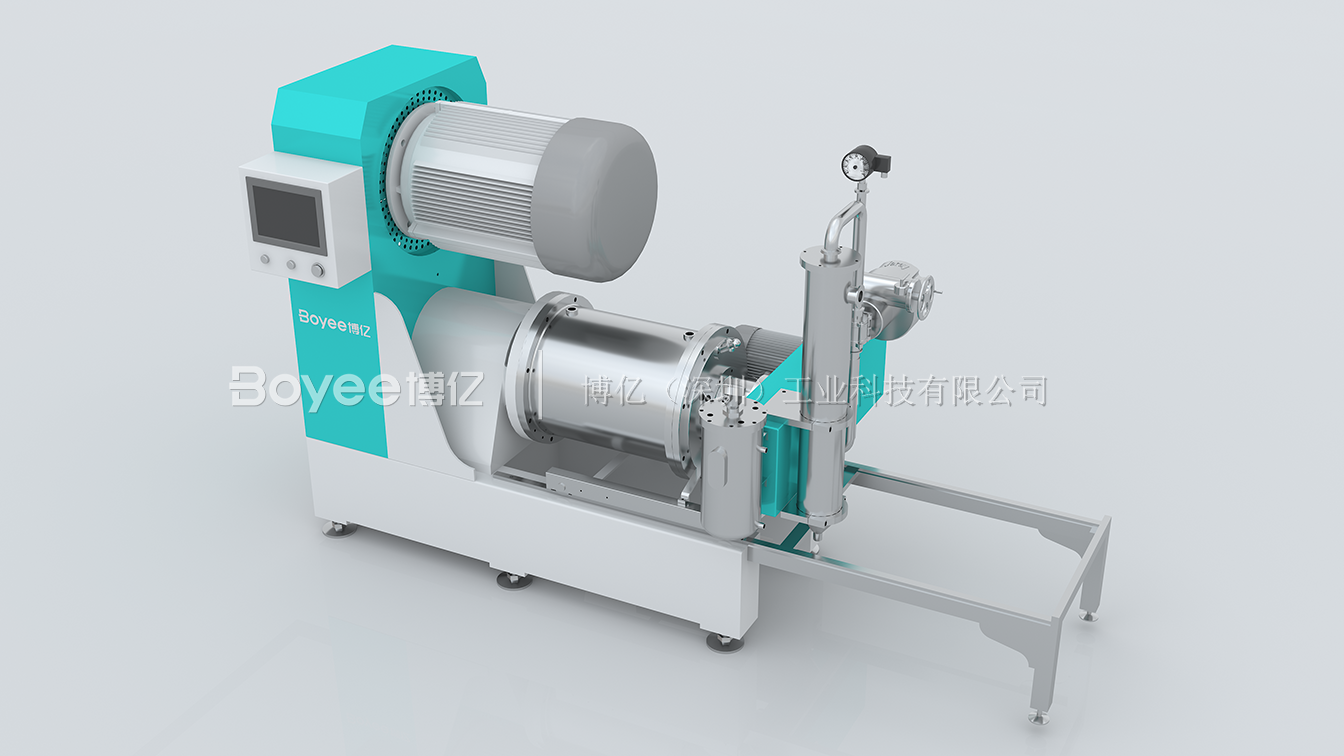 Pictured: Boyee Industrial LMM Ultrafine Centrifugal Nano Bead Mill
Key challenges addressed include: low-damage depolymerization, particle size distribution control, low-contamination grinding, temperature rise control, cycle stability, and batch consistency.
For MLCC electronic ceramic applications, Boyee can configure LMM centrifugal nano-bead mills, NMM high-flow nano-bead mills, dual-planetary mixers, and high-pressure homogenizers to meet the process requirements of various powders and slurries.
5. From Nano bead Mills to High-End Intelligent Production Lines for Electronic Materials
Once mass production begins, individual machine performance is only one aspect of the process. Additional challenges must be addressed, including: matching equipment capacity, process integration, stable material transfer, cross-contamination, parameter traceability, and batch consistency. Therefore, Boyee can configure equipment based on specific material processing requirements.
In the field of MLCC electronic ceramic production lines, Boyee covers the entire process: feeding → mixing → spray drying → sintering → crushing → wet grinding → drying → heat treatment → batch blending → screening and packaging.
This forms an engineering solution ranging from core equipment to smart production lines and turnkey (EPC) projects.
6. High-End Electronic Materials Manufacturing: Shifting from “Stand-Alone Equipment” to “System Capabilities”
For MLCC electronic ceramics, semiconductor materials, and advanced electronic slurries, the stability of large-scale production is not determined solely by the nanometer resolution that equipment can achieve.
What matters even more is: whether the particle state is stable, whether material purity is controllable, whether the slurry remains stable over the long term, whether batch consistency is maintained, and whether experimental processes can be scaled up.
Boyee Industrial continues to expand its capabilities in nano-grinding, mixing and dispersion, homogenization, automated control, and turnkey EPC solutions for entire production lines. The company provides engineering solutions—ranging from experimental validation, process optimization, and core equipment to the construction of smart production lines—for MLCC electronic ceramics, CMP slurries, photoresists, semiconductor materials, electronic pastes, and high-end functional materials.