
















Achieving a stable and narrow particle size distribution with a nano bead mill depends on more than the machine itself. Grinding performance is determined by a connected set of process variables, including the target fineness, feed particle size, grinding media, rotor and separator design, slurry viscosity, temperature, flow rate and operating pressure.For manufacturers processing battery materials, ceramic slurries, conductive additives, pigments or high-viscosity inks, understanding these variables is essential for improving bead mill grinding efficiency, reducing contamination and maintaining consistent production quality.
1.Define the Target Particle Size and Distribution
Before selecting a bead grinding machine, manufacturers should first define the required particle size and how it will be measured.
A target described only as “100 nm” is not sufficient. Engineers should clarify whether it refers to D50, D90, the primary particle size or the size of dispersed agglomerates. The required particle size distribution influences the rotor structure, separator design, grinding media size, specific energy input and number of circulation passes.
For submicron and nano-scale processing, a high-energy pin-type or disc-type grinding system is often combined with a dynamic or centrifugal bead separator. Compared with conventional screen separation, this configuration can support smaller grinding media and provide more stable media retention under suitable operating conditions.
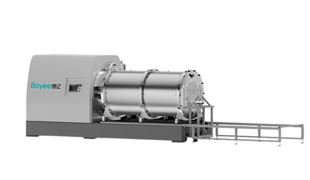
Boyee horizontal nano bead mill and vertical ceramic bead millsystems can be configured according to the material characteristics, target fineness, contamination requirements and production capacity.
2.Grinding media size is one of the most important factors in wet grinding.
Larger beads provide greater impact energy and are generally used for pre-grinding, hard particles and micron-scale size reduction. Smaller beads provide more contact points per unit volume and are therefore commonly selected for fine grinding and nano dispersion.
However, grinding media should not be selected according to target particle size alone. Engineers should also consider:
● Feed particle size and particle hardness
● Slurry viscosity and solids content
● Required impact and shear intensity
● Rotor speed and specific energy input
● Grinding chamber material
● Separator capability
● Acceptable contamination level
Yttria-stabilized zirconia grinding beads are widely used because of their density, wear resistance and grinding efficiency. Depending on the application, ceramic media with different compositions, densities and bead sizes may also be considered.
Targets below approximately 50 nm may require very small grinding media and a high-efficiency separation system. The achievable result must be verified through material testing because formulation, dispersion stability and particle measurement methods can significantly affect the reported particle size.
3. Select the Correct Bead Separation System
The separation system determines whether the grinding media can remain inside the chamber while the processed slurry exits continuously.
Conventional screen separation is reliable for many micron and submicron applications, but the screen gap limits the minimum usable bead size. Very small beads may increase the risk of screen blockage, bead leakage or unstable discharge.
A dynamic or centrifugal separation system uses rotational and centrifugal forces to retain the grinding media inside the chamber. This design extends the usable range of smaller media and is commonly applied in horizontal nano bead mills and ultra-fine bead mills.
However, the minimum usable bead size still depends on the separator structure, rotational speed, slurry viscosity, bead density and flow rate. Separator selection should therefore be based on actual process conditions rather than target fineness alone.
4. Maintain a Stable Grinding Temperature
Wet grinding generates heat through bead collision, rotor movement, fluid shear and pumping.
If the temperature rises excessively, the slurry viscosity may change, solvents may evaporate and temperature-sensitive materials may degrade. These effects can reduce dispersion stability and cause variations between production batches.
An effective bead mill cooling system should include:
● A grinding chamber with sufficient heat-transfer area
● Stable chilled-water temperature and flow
● Continuous product-temperature monitoring
● Appropriate feed rate and rotor speed
● Temperature alarms and interlocks when required
The objective is not to operate at the lowest possible temperature. Instead, the process should remain within a stable temperature window suitable for the material. In some formulations, excessive cooling may increase viscosity and reduce slurry mobility.
For battery materials and other temperature-sensitive products, stable temperature control is often more important than simply lowering the cooling-water setpoint.
5. Control Flow Rate and Chamber Operating Pressure
Grinding chamber pressure is mainly generated by pumping, slurry viscosity, flow resistance and the bead separation system. It should be treated as an operating indicator rather than a direct source of grinding energy.
A stable pressure range generally indicates controlled slurry flow through the grinding chamber. An abnormal pressure increase may indicate:
● Excessive slurry viscosity
● An unsuitable feed rate
● Separator restriction or blockage
● Excessive media filling
● Poor temperature control
● Product accumulation inside the system
Increasing pump pressure does not automatically improve grinding efficiency. Excessive operating pressure can increase mechanical load, raise product temperature and affect discharge stability.
For sealed bead mill systems or inert-gas-protected grinding lines, pressure monitoring is particularly important because stable system pressure supports safe, closed processing of moisture-sensitive or oxidation-sensitive materials.
6. Consider Specific Energy and Residence Time
Particle size reduction is also closely related to the energy transferred to each unit of material.
If the residence time is too short, particles may leave the chamber before sufficient grinding has occurred. If it is too long, the process may consume unnecessary energy and increase wear or contamination risk.
A circulation grinding system allows the material to pass through the bead mill repeatedly until the required particle size distribution is achieved. During scale-up, engineers should evaluate specific energy consumption, flow rate, circulation time and particle size development together rather than relying only on machine power.
7. Why These Factors Matter for Battery and Advanced Materials
Advanced battery materials leave little room for uncontrolled grinding conditions.
Silicon-carbon anode materials require stable particle size and contamination control. Solid-state electrolyte powders may be sensitive to moisture, oxygen and metallic impurities. Carbon nanotube conductive slurries require effective deagglomeration without excessive damage to the nanotube structure.
For these applications, a nano bead millshould not be treated as an isolated machine. Mixing, powder feeding, pre-dispersion, wet grinding, temperature control, filtration, closed conveying and automation all influence the final product quality.
Boyee develops battery material production lines that integrate mixing, dispersion, nano grinding, closed powder handling and automated process control. By matching the bead mill with upstream and downstream equipment, manufacturers can maintain better control over particle size distribution, slurry temperature, media wear and batch consistency from raw-material feeding to finished slurry.
Selecting a Nano Bead Mill for Your Process
The correct horizontal nano bead mill or vertical ceramic bead mill should be selected according to the complete process requirement, including:
● Material type and hardness
● Feed and target particle size
● Slurry viscosity and solids content
● Grinding media size and material
● Contamination limitations
● Required production capacity
● Cooling demand
● Batch or continuous operation
● Closed, vacuum or inert-gas processing requirements
Material testing before equipment selection can help determine the appropriate rotor, separator, media size, operating speed and circulation strategy.
For manufacturers developing battery materials, electronic ceramics, nano pigments or conductive slurries, a properly configured ultra-fine bead mill can improve grinding efficiency, product consistency and long-term production reliability.
