
















With the rapid development of new energy vehicles, energy storage system, and next-generation battery technologies, solid-state batteries are becoming a key focus of the global battery industry due to their high safety, high energy density, and excellent cycle performance.
Compared to traditional lithium-ion batteries using liquid electrolytes, solid-state batteries use solid-state electrolytes instead, and the performance and stable manufacturing capabilities of solid-state electrolyte materials directly influence the commercialization progress of solid-state batteries.
Currently, the mainstream solid-state electrolyte technology routes in the industry primarily include:
· Oxide solid-state electrolytes
· Sulfide solid-state electrolytes
· Polymer solid-state electrolytes
Among these, oxide solid-state electrolytes have attracted widespread attention for their high stability and excellent safety; typical materials include LLZO and LATP. Sulfide solid-state electrolytes, with their high ionic conductivity and excellent interfacial contact properties, are considered one of the most promising material systems for next-generation high-performance solid-state batteries.
However, transitioning from laboratory-scale material validation to ton-scale production remains challenging. Key challenges include powder consistency, moisture and atmosphere control, material stability, equipment compatibility, and process scale-up.To address these industrialization challenges, BOYEE provides comprehensive solid-state electrolyte production line solutions covering process design, equipment manufacturing, system integration, installation, commissioning, and EPC turnkey delivery. Through integrated process engineering and advanced equipment solutions, BOYEE helps customers accelerate the transition of oxide and sulfide solid-state electrolytes from experimental development to large-scale manufacturing.
1. Analysis of Production Routes for Oxide Solid-State Electrolytes: Addressing Challenges in Powder Uniformity and Sintering Consistency
Oxide solid-state electrolytes are characterized by high air stability and good chemical stability, making them one of the most promising solid-state battery material technologies currently advancing toward industrialization.
Representative oxide solid-state electrolytes, such as LLZO (Lithium Lanthanum Zirconate) and LATP (Lithium Aluminum Titanium Phosphate), typically undergo a series of critical manufacturing processes, including:
Raw material feeding → Powder metering and batching→ Wet mixing → Pre-dispersion → Spray drying → Sintering → Crushing → Coarse grinding/fine grinding → Jet milling → Screening and demagnetization → Finalpackaging
During large-scale production, oxide solid-state electrolyte manufacturing faces several key challenges1)
1) High standards for the uniformity of powder mixing
During the production of oxide solid-state electrolytes, multiple metal oxides and lithium-containing compounds must be accurately proportioned and uniformly mixed. Insufficient mixing or uneven particle distribution may result in non-uniform phase formation during sintering, negatively affecting ionic conductivity and overall material performance.To address this challenge, BOYEE integrates wet mixing, pre-dispersion, and fine grinding technologies to improve raw material homogeneity, reduce particle agglomeration, and enhance the consistency of subsequent sintering processes.
2) Difficulty in Crushing and Deagglomeration After Sintering
After high-temperature sintering, oxide solid-state electrolyte materials typically form hard agglomerates with high mechanical strength. Conventional size reduction methods, such as air jet milling alone, may face limitations including high equipment wear, insufficient deagglomeration efficiency, and difficulties in achieving uniform particle size distribution.To overcome these challenges, BOYEE provides an integrated post-sintering powder processing solution combining pre-crushing, turbine bead milling, and air jet milling technologies. The process begins with mechanical pre-crushing methods, such as jaw crushing or double-roll crushing, to reduce the size of sintered blocks and lower the processing load on downstream equipment. A turbine bead mill is then applied for efficient deagglomeration and particle refinement. Through controlled shear and impact forces, the system enables precise particle size control while maintaining powder uniformity
3) Strict Environmental Control to Prevent Moisture AbsorptionAlthough oxide solid-state electrolytes generally exhibit better air stability compared with sulfide systems, moisture control remains critical during production, storage, and transportation to maintain material performance.
BOYEE solid-state electrolyte production lines incorporate multiple environmental protection measures, including:
· Controlled temperature and humidity environments
· Nitrogen-protected material conveying
· Slight positive-pressure design for storage silos and tanks
· Fully enclosed powder transfer systems
These technologies minimize moisture exposure, improve material stability, and ensure consistent product quality throughout the manufacturing process.
2. Analysis of Production Routes for Sulfide Solid-State Electrolytes: An Anhydrous and Oxygen-Free Environment Is the Key Requirement
Compared with oxide solid-state electrolytes, sulfide solid-state electrolytes offer significantly higher ionic conductivity and superior interfacial contact properties, making them one of the most promising material systems for next-generation solid-state batteries.
However, sulfide electrolytes are considerably more challenging to manufacture due to their extreme sensitivity to moisture and oxygen. Exposure to water or air may trigger chemical reactions that affect material stability and electrochemical performance. In addition, certain sulfide processing steps may generate sulfur-containing exhaust gases, requiring advanced environmental control, safety management, and exhaust treatment systems.
The production process for sulfide solid-state electrolytes includes: raw material pretreatment → batching and mixing → wet grinding → vacuum filtration (solvent recovery) → drying → sintering → jet milling → screening and packaging
1) Production Environment with Low Dew Point and Low Oxygen Content
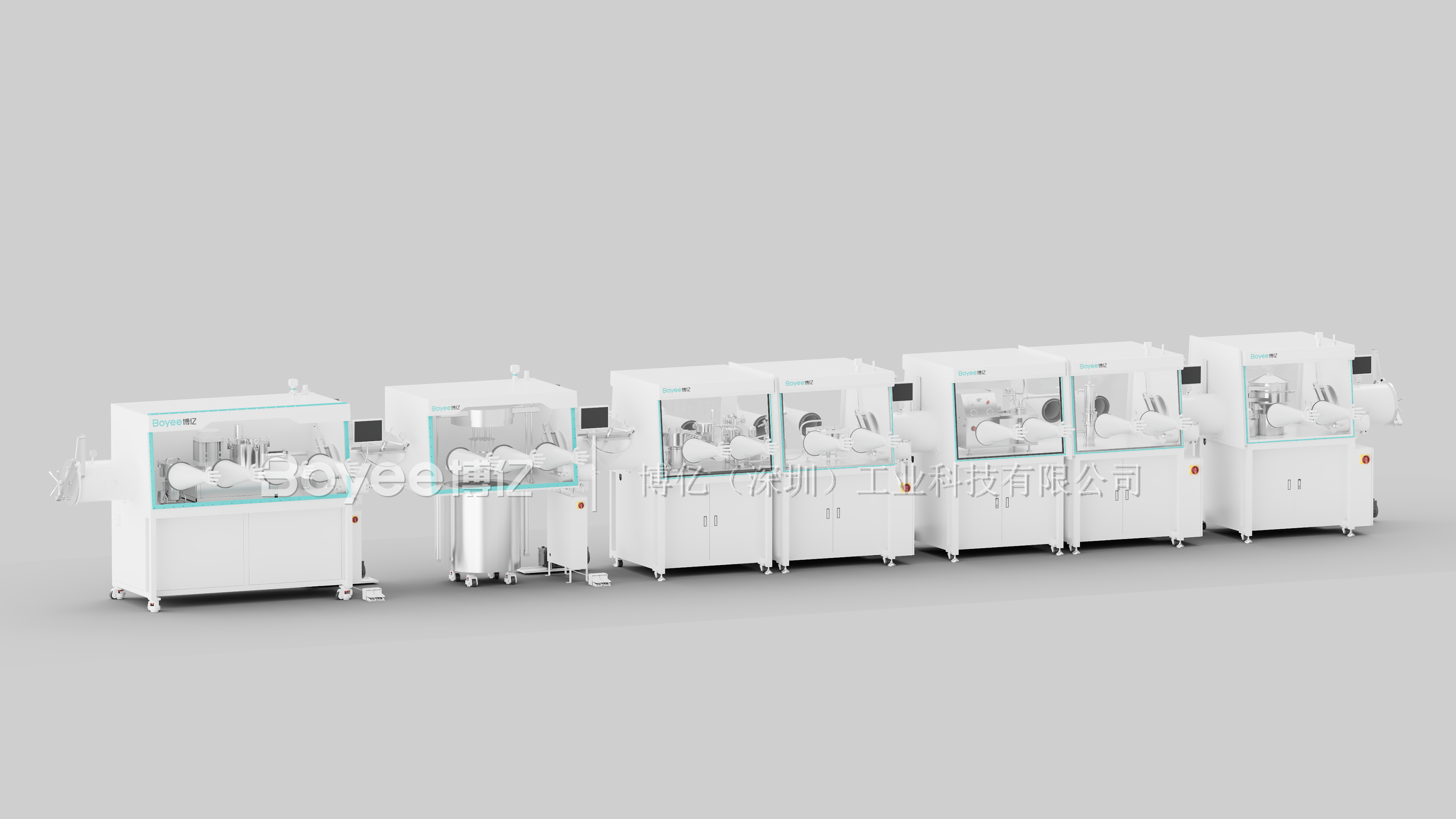
The production of sulfide solid-state electrolytes must avoid the effects of moisture and oxygen. Boyee achieves this by implementing an inert gas protection system, an argon-flushed environment, a low-dew-point dehumidification system, sealed conveying equipment, and a glove box workspace. This creates a water-free, oxygen-free production environment, thereby enhancing product stability.2) Control of Powder Agglomeration
Sulfide solid electrolyte powders are prone to particle agglomeration, which negatively affects material performance and subsequent applications. To address this issue, Boyee employs the following methods: adding dispersants, high-energy mechanical dispersion, and surface modification. These approaches improve particle surface characteristics, enhance powder dispersibility, and achieve more uniform particle distribution for downstream applications.
3) Corrosion and Exhaust Gas Treatment
During sulfide electrolyte production, sulfur-containing compounds may be generated, while certain materials may also present corrosion risks to processing equipment.To ensure safe and reliable operation, BOYEE solid-state electrolyte production lines incorporate: Corrosion-resistant equipment materials, Protective surface coating technologies, Spray pre-treatment systems, Activated carbon adsorption systems.
These solutions help maintain equipment durability while meeting industrial safety and environmental protection requirements.
3. Complete Line Solutions for Oxide and Sulfide Solid-State Electrolytes
Boyee Industrial offers modular production line solutions for solid-state electrolytes tailored to different material pathways.
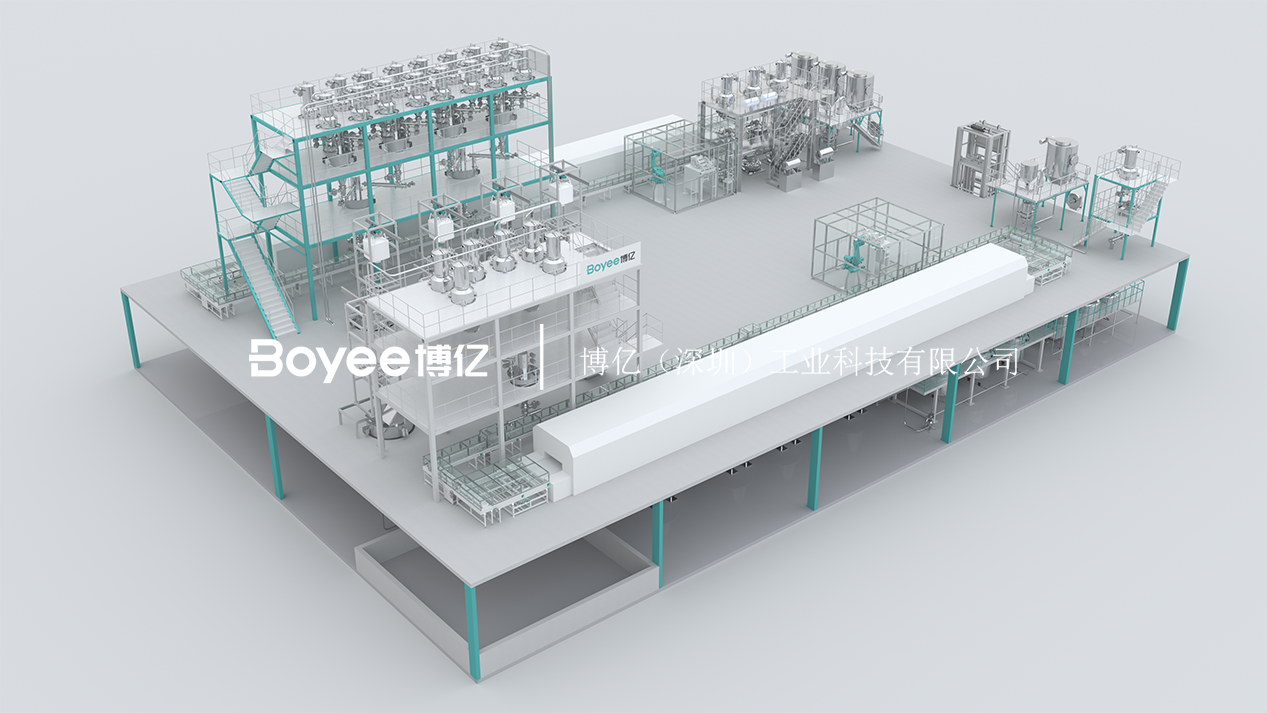
The oxide solid-state electrolyte production line covers automatic raw material feeding, precise batching, wet mixing, pre-mixing and dispersion, sintering systems, coarse and fine grinding, jet milling, screening, and packaging, enabling the stable production of oxide solid-state electrolyte powders.
4. Sulfide Solid-State Electrolyte Production Line
Covering an anhydrous and oxygen-free production environment, inert gas protection, sealed conveying, wet grinding, solvent recovery, sintering, exhaust gas treatment, and automated packaging, this process enables the scalable production of high-purity sulfide solid-state electrolytes
5. Boyee Industrial: Your Equipment Partner for Solid-State Electrolytes—From Experimental Validation to Mass Production and Delivery
Boyee continues to focus on the intelligent equipment solution for new energy materials. Addressing the industrialization needs of the solid-state battery sector, the company provides production lines for oxide and sulfide solid-state electrolytes, solid-state battery materials processing equipment, solid-state electrolyte preparation equipment, and EPC solutions for solid-state electrolytes.
Leveraging its in-house R&D capabilities in grinding, mixing, dispersion, and automation equipment, Boyee delivers comprehensive solutions—from laboratory validation and pilot-scale development to metric-ton-scale mass production—tailored to customers’ material systems and production capacity plans.
From material process development to production line construction, and from core equipment manufacturing to turnkey EPC delivery, Boyee Industrial helps solid-state battery material companies accelerate commercialization and move toward large-scale manufacturing.