
















1. Why Are “Mixing” and “Fibrillation” the Biggest Challenges in Dry-Process Electrodes?
Unlike traditional wet-process electrodes, dry-process electrodes minimize solvent use by directly mixing active materials, conductive agents, and binders in a dry state, and achieve binder fibrillation through mechanical action.
Once the process enters full-scale production, the key challenge is not merely “mixing” several powders together, but simultaneously addressing the following issues:
Are the powders uniformly dispersed?
Can agglomerates of the conductive agent be effectively broken up?
Can the binder form a stable fibrous structure?
Is the temperature rise during the mixing process controllable?
After scaling up from the laboratory to mass production, can the process be consistently replicated?
These factors directly impact the consistency of subsequent electrode film formation and the ability to achieve continuous production.
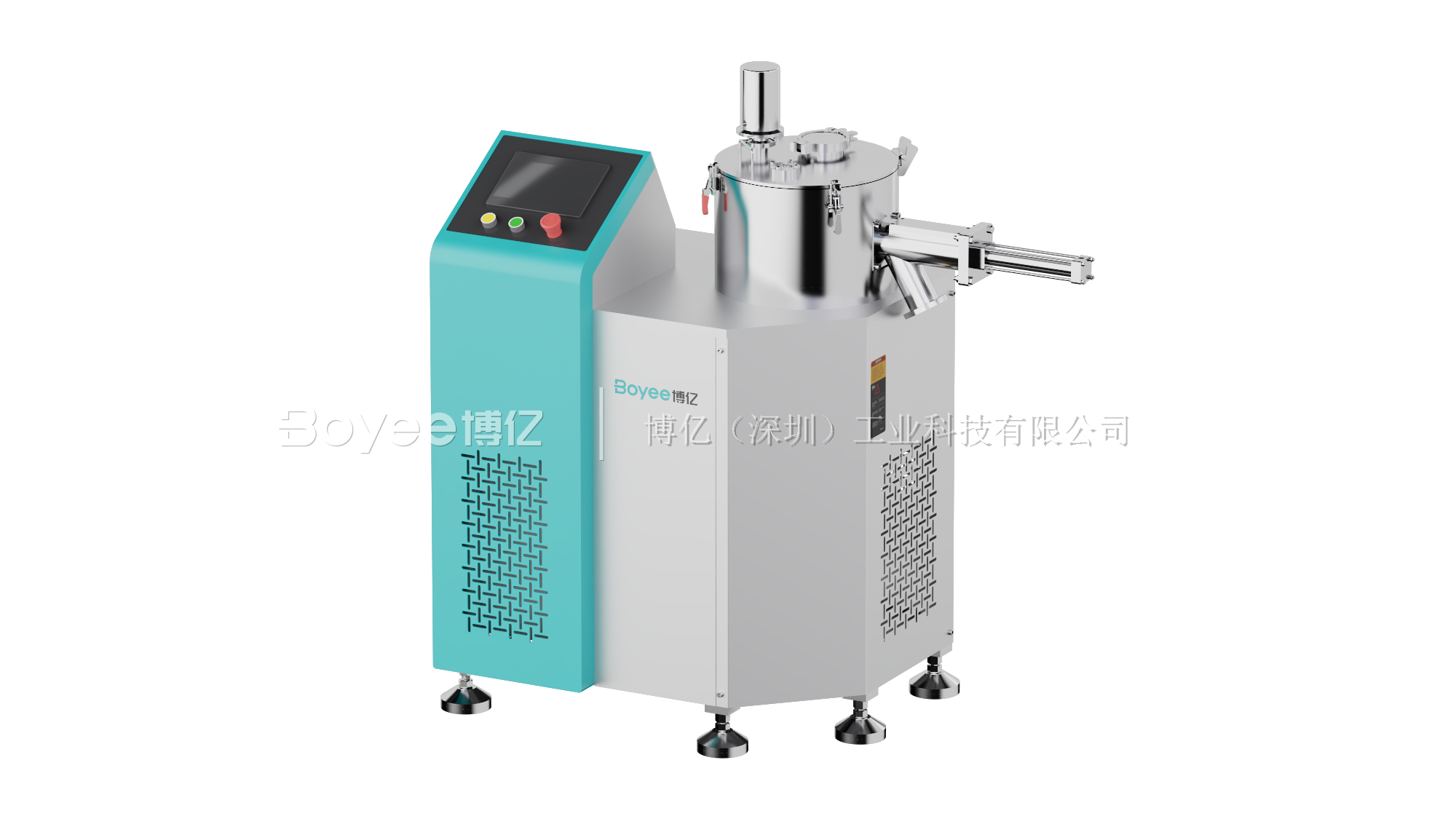
2. Application of Boyee Industrial High-Speed Mixers in Dry-Process Electrodes
To meet the requirements for powder mixing and fibrillation in dry-process electrodes, Boyee high-speed mixers utilize the coordinated operation of lower, middle, and upper paddles to continuously circulate the material within the mixing chamber. Through shearing, collision, friction, and dispersion, they effectively address issues such as powder agglomeration and uneven mixing.
The lower paddle drives the material to form a circulating flow, while the middle and upper paddles further perform high-speed shearing and dispersion, enabling different powder components to collide, diffuse, and mix thoroughly. Boyee Industrial positions this equipment as a powder processing machine that integrates mixing, grinding, and plasticization, and explicitly states that intense friction mixing can meet process requirements such as coating and fibrillation.
1) Uniform Mixing
The high-speed circulation combined with the synergistic three-paddle structure ensures that active materials, conductive agents, and binders continuously flow within the chamber, reducing localized accumulation and uneven powder mixing.
2) Shear Dispersion
The middle and upper paddles operate at high speeds, breaking up agglomerates through shear and impact, further dispersing powders of different particle sizes and densities to improve mixing uniformity.
3) Adaptability to Fibrillation Processes
During dry electrode preparation, mechanical shearing and friction are required to promote the formation of a fibrillated network by the binder. The Boyee High-Speed Mixer supports intense friction mixing and adjustable operating speeds, allowing high-, medium-, and low-speed setting, providing varying energy inputs for mixing, dispersion, and fibrillation steps.
4) Temperature and Atmosphere Control
During dry mixing, mechanical friction generates heat, making temperature control equally important. Boyee high-speed mixers support ambient, low-temperature, and sub-zero temperature control and can be configured with functions such as vacuum-sealed mixing, nitrogen inerting, and oxygen concentration monitoring to accommodate powder systems that are more sensitive to temperature and atmosphere.
3. From Experimental Validation to Production Scale-up
One of the challenges in the industrialization of dry-process electrodes is how to reliably scale up the mixing and fibrillation conditions established during the experimental phase.
Boyee’s high-speed mixers are available in a range of specifications, allowing for equipment selection and process optimization based on material systems, throughput, and process requirements. With effective volumes ranging from 4 L to 170 L, these mixers can be used for the validation and scale-up of powder mixing processes at various stages.
For dry-process electrode preparation, Boyee can provide high-speed mixing equipment and related process solutions tailored to customers’ material systems, formulation ratios, mixing requirements, fibrillation objectives, and production capacity needs.
FAQ
l Why does the dry-process electrode require high-speed mixing?
Dry-process electrodes do not rely on solvent dispersion; instead, they require mechanical shearing, collision, and friction to achieve uniform mixing of active materials, conductive agents, and binders, while also providing the energy needed for binder fibrillation.
l What key issues do high-speed mixers primarily address in dry-process electrodes?
They are primarily used for uniform powder mixing, agglomerate breaking, shear dispersion, and adaptation to the fibrillation process, while improving process stability through control of speed, temperature, and atmosphere.
l Do Boyee high-speed mixers support process scale-up?
Boyee high-speed mixers are available in a range of effective working volumes. Equipment selection and process adaptation can be tailored to meet the needs of laboratory, pilot, and full-scale production.
