
















All-solid-state batteries have entered the engineering validation phase, and competition within the industry is shifting.
In 2026, the global all-solid-state battery industry is moving beyond laboratory R&D and entering the engineering validation and industrialization preparation stages.
A recent TrendForce report indicates that the maturity of all-solid-state battery technology will continue to improve in 2026. Some leading companies in China, Japan, and South Korea have progressed from laboratory proof-of-concept to the engineering validation phase, with automotive-grade testing and small-scale pilot production accelerating significantly.
This also means that the industry’s focus is shifting from “How high can material performance be achieved?”
to questions such as: Can materials be produced stably? Can laboratory processes be scaled up? Can consistent performance across batches be guaranteed? And can the entire production line operate continuously?
As one of the core materials for all-solid-state batteries, the ability to manufacture solid-state electrolytes at scale is becoming a crucial foundation for industrialization.
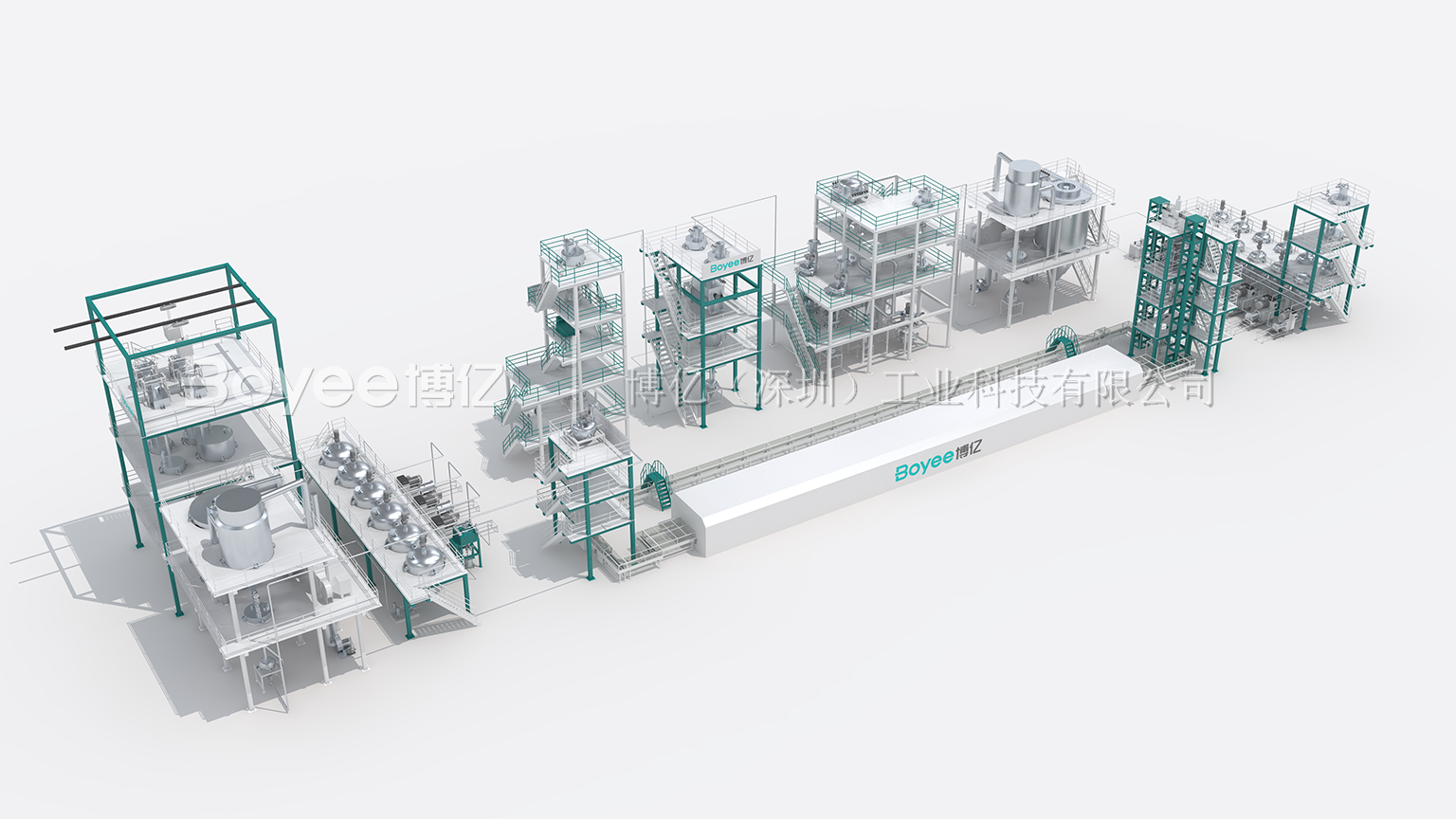 Pictured: Boyee Industrial's Oxide Solid-State Electrolytes Production Line Solution
1. Oxides and Sulfides: Each Industrialization Path Faces Its Own Challenges
Currently, oxides and sulfides represent key technical pathways for the industrialization of solid-state electrolytes.
Oxide solid-state electrolytes, such as LLZO, LLTO, and LATP, exhibit good chemical stability; however, large-scale production still requires solutions to issues such as particle size control, sintering densification, and interfacial and grain boundary resistance.
Sulfide solid-state electrolytes, on the other hand, have attracted industry attention due to their high ionic conductivity and good processability. However, they impose stricter requirements on the production environment, material purity, and interface stability—particularly regarding the control of moisture and oxygen, sealed production processes, and related safety systems.
Therefore, the transition from laboratory-scale materials to large-scale production truly tests not only the formulation but also the following:
Can particle size be consistently controlled and reduced?
Can the mixture remain uniform?
Can impurities and contamination be controlled?
Can heat treatment ensure batch-to-batch consistency?
Can the entire production environment remain stable over the long term?
These are also the issues that the solid-state electrolyte industry must resolve as it transitions from “materials R&D” to “engineering and manufacturing.”
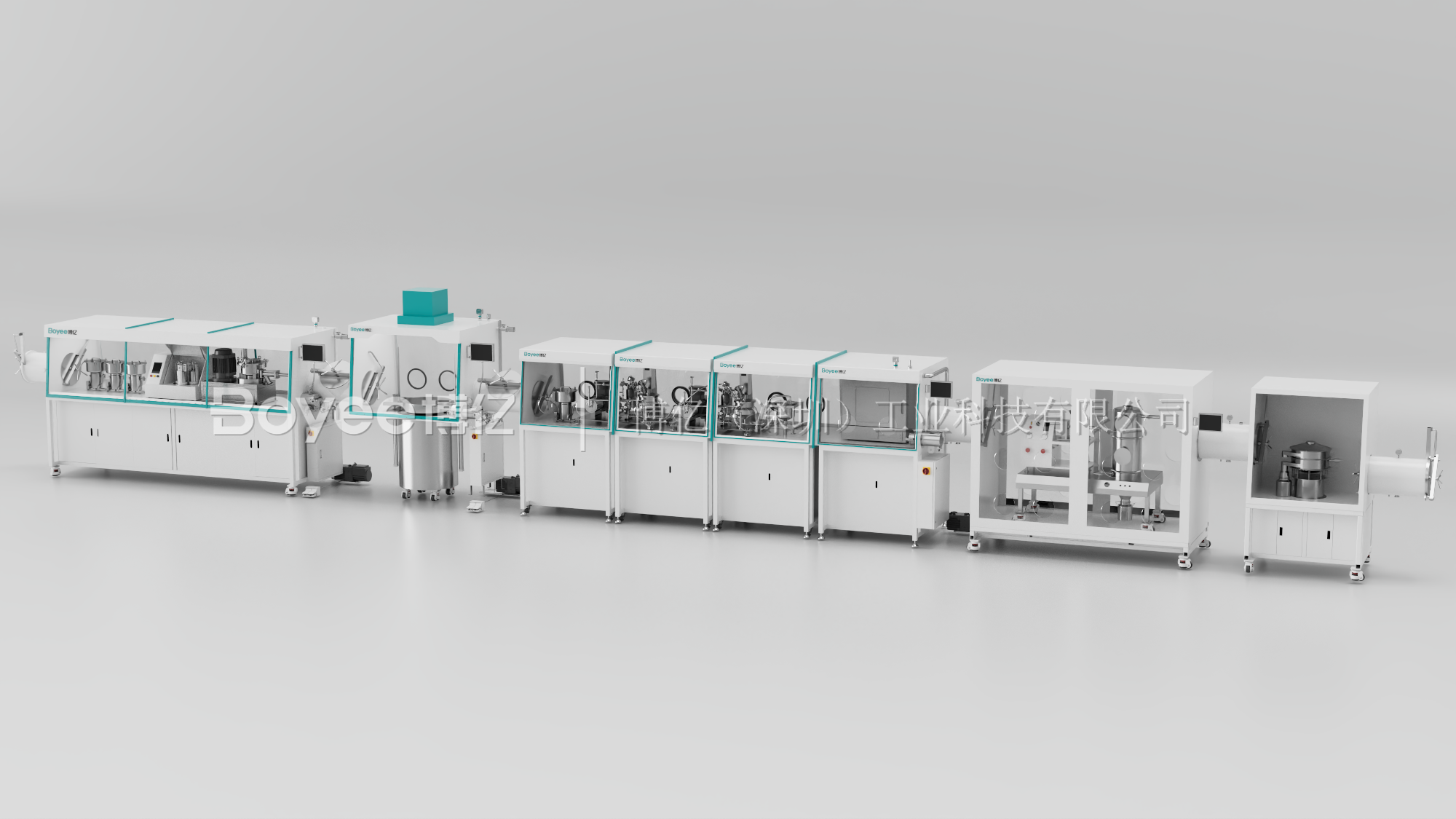 Pictured: Boyee Industrial's Sulfide Solid-State Electrolytes Production Line Solution
2. From “Producing Materials” to “Stable Manufacturing of Materials”
Scaling up laboratory-scale validation processes—which involve tens of grams or a few kilograms—to production at the metric ton or even thousand-metric-ton level is not simply a matter of enlarging equipment. As production capacity increases, factors such as grinding energy, material conveyance, mixing uniformity, temperature control, environmental control, and process integration between equipment all undergo changes.
Therefore, a solid-state electrolyte production line truly geared toward industrialization must break down the material processing into controllable, repeatable engineering processes.
For oxide solid-state electrolytes, the process flow involves: feeding from ton bags → powder metering and batching → wet mixing → spray drying → sintering → crushing → pre-mixing and dispersion → coarse grinding, fine grinding → spray drying → vacuum drying → jet milling → blending → sieving/ magnetic separation→ finished product packaging.
For sulfide solid-state electrolytes, the focus is on: low-moisture and low-oxygen environments, sealed feeding and conveying, low-contamination grinding, heat treatment, exhaust gas treatment, safety interlocks, and automated control.
True engineering capability does not simply involve connecting these pieces of equipment; rather, it involves organizing each process step around material requirements to form a stable, continuous, and reproducible production system.
3. Boyee: From Experimental Validation to Complete Solid-State Electrolyte Production Line Engineering
Addressing the industrialization needs of solid-state electrolytes, Boyee Industrial has established a comprehensive technology and equipment system covering experimental validation, pilot-scale development, core equipment, complete production line design, automated control, and EPC project delivery.
In the field of oxide solid-state electrolytes, Boyee has configured processes and equipment focused on low-pollution grinding, uniform mixing, heat treatment, and batch consistency control. These solutions are compatible with material systems such as LLZO, LLTO, and LATP, and the company has already implemented ton-scale and large-scale turnkey projects.
For sulfide solid-state electrolytes, Boyee has designed systems centered on key industrialization steps such as low-moisture and low-oxygen conditions, sealed conveying, low-contamination grinding, heat treatment, exhaust gas purification, and safety interlocks, and is continuously advancing from kilogram-scale validation to larger-scale production.
Rather than simply supplying individual pieces of equipment, Boyee focuses on how to reliably replicate laboratory-validated processes on industrial production lines.
4. Engineering Capabilities Are Becoming a Key Competitive Advantage in the Commercialization of Solid-State Batteries
Competition in the solid-state battery sector is no longer limited to competition among different material systems. From material testing to engineering validation, and from pilot production lines to large-scale manufacturing, the importance of process scale-up, core equipment, production environments, automated control, and engineering and project delivery capabilities is continuing to grow.
Research in 2026 is increasingly shifting its focus from purely material performance to interface engineering, manufacturing processes, and industrialization pathways, indicating that solid-state batteries are entering a development phase that places greater emphasis on engineering capabilities.
For equipment manufacturers, the real challenge to be addressed is becoming increasingly clear: it is not whether “the materials can be produced,” but whether effective processes can be replicated consistently, stably, and over the long term.
Leveraging its 40,000-square-meter intelligent manufacturing base and capabilities in R&D, processing, assembly, and full-line integration, Boyee Industrial is continuously advancing the engineering applications of equipment for oxide and sulfide solid-state electrolytes, as well as other advanced battery materials.
From experimental validation to process scale-up; from core equipment to turnkey EPC (Engineering, Procurement, and Construction) for complete production lines; and from material processing to mass production.
Boyee Industrial will continue to focus on the industrialization needs of solid-state batteries, driving the transformation of advanced material processes into industrial production lines scalable, reproducible, and capable of continuous operation.
