
















Is adjusting the deposition temperature the most critical factor in the production of CVD silicon-carbon anodes? It’s not quite that simple.
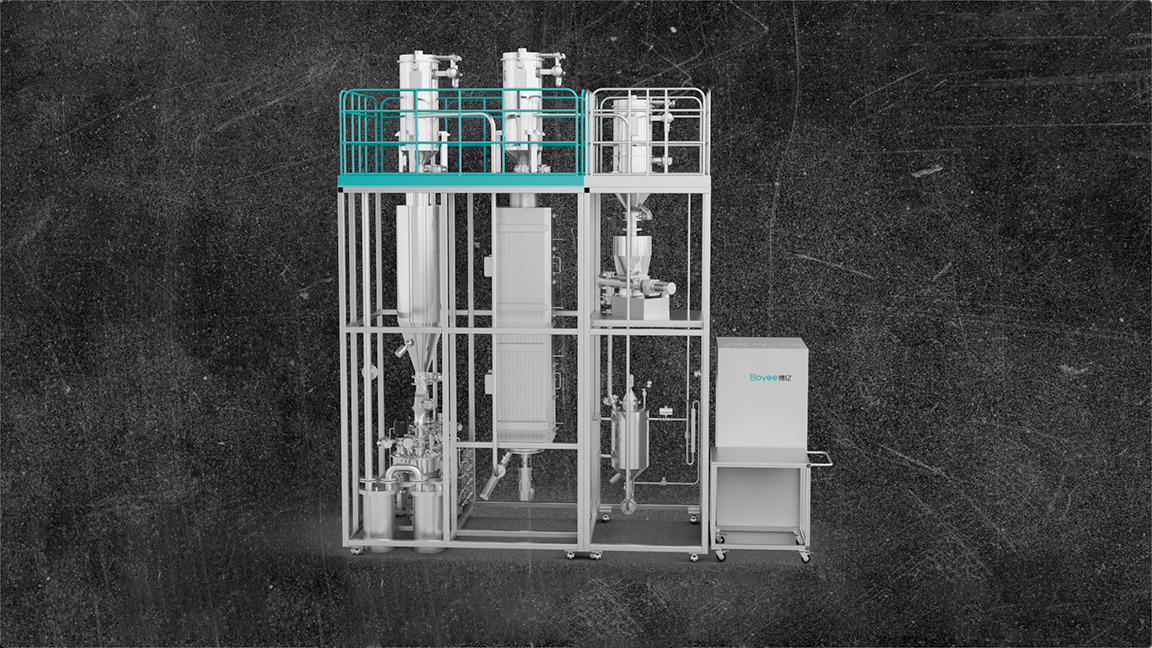
Pictured: Boyee Industrial Fluidized Bed Equipment
In 2026, *Chemical Engineering Science* published a study on the preparation of silicon-carbon anode materials via fluidized-bed chemical vapor deposition (CVD), focusing on: SiH₄ pyrolysis temperature, SiH₄ deposition time, gas velocity, minimum fluidization velocity (U/Umf), silicon content, and carbon coating integrity.
This indicates that the real challenge in the industrialization of CVD silicon-carbon anodes is not simply a question of whether silicon can be deposited, but rather how to achieve uniform, stable, and controllable silane deposition.
1. Higher temperatures are not necessarily better
In fluidized-bed CVD, after silane pyrolysis, nanosilicon is deposited onto the interior or surface of porous carbon.
The pyrolysis temperature of SiH₄ affects the deposition rate, particle morphology, and structural state of the silicon. Excessively high temperatures may lead to localized over-deposition, particle agglomeration, or pore blockage; conversely, insufficient temperatures will impair silicon source utilization and silicon loading capacity.
Therefore, industrial-scale fluidized-bed CVD equipment must not only control the temperature but also ensure a stable and uniform temperature distribution within the reaction zone.

2. More Silane Deposition is Not Necessarily Better
Extending the SiH₄ deposition time typically increases the silicon content, but a higher silicon loading is not always better. Excessively high silicon content may exacerbate volume expansion and compromise structural stability; conversely, if the content is too low, it becomes difficult to leverage the capacity advantages of silicon materials.
Therefore, silane deposition requires simultaneous control of silicon content, deposition uniformity, and batch consistency. These are also the issues that must be resolved as CVD silicon-carbon anodes transition from the laboratory to large-scale production.
3. Why Is the Fluidization State So Critical?
In a fluidized bed, gas keeps the porous carbon particles in a fluidized state, enhancing gas-solid contact, particle mixing, and mass transfer efficiency. If the gas velocity is too low, insufficient fluidization is likely to occur; if it is too high, particle entrainment and reaction fluctuations may occur.
Therefore, the engineering scale-up of CVD silicon-carbon anodes is not simply a matter of proportionally scaling up equipment and gas flow rates; rather, it requires the coordinated optimization of the reactor size, loading capacity, gas flow rate, and fluidization state. This is also one of the core engineering challenges in scaling up fluidized-bed CVD equipment.
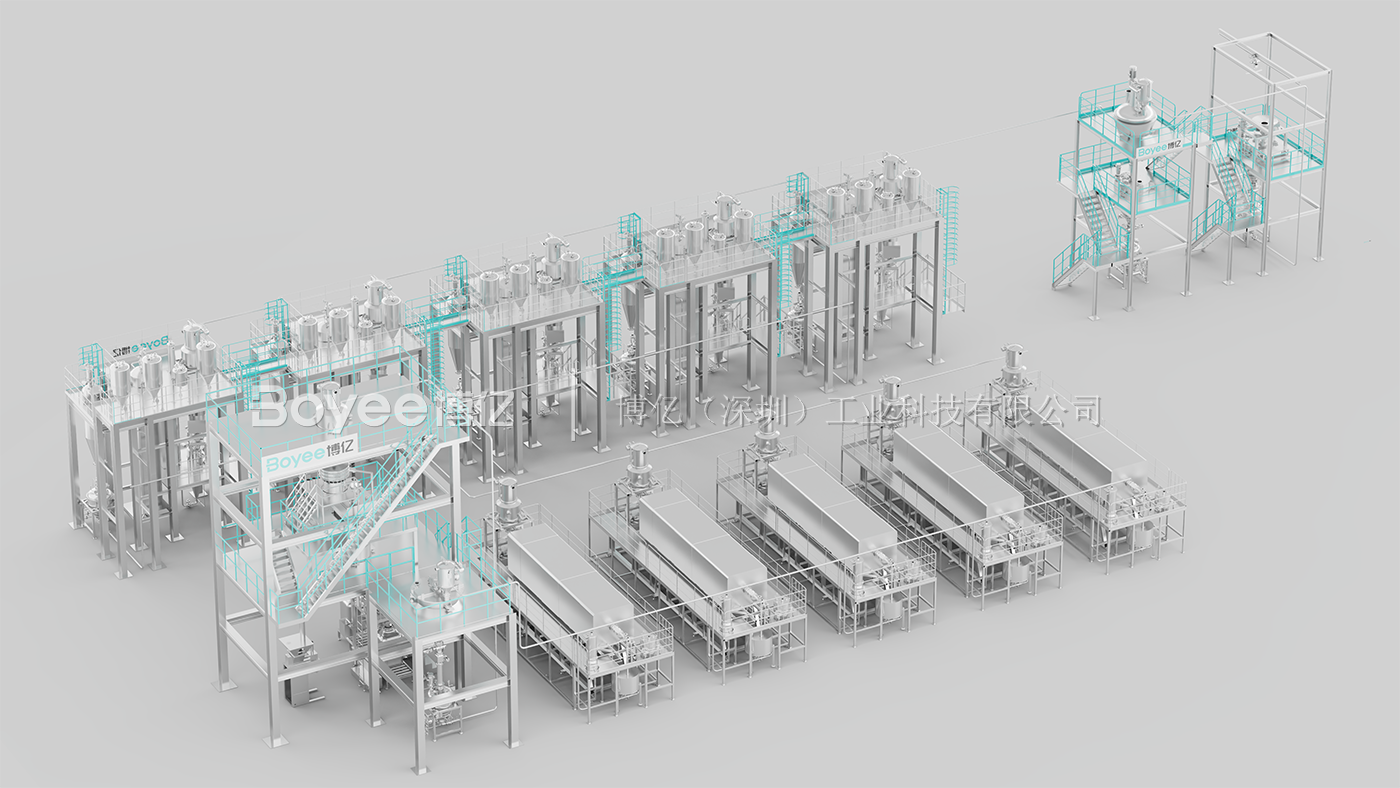
Pictured: Boyee Industrial’s CVD silicon-carbon anode production line solution
4. From the Lab to Mass Production: The Challenge Lies in “Consistent Reproducibility”
The laboratory addresses the question: “Can silicon be deposited?”
Industrialization focuses more on: whether the deposition is uniform, whether the silicon content is stable, whether the fluidization state is consistent, whether batch-to-batch reproducibility is achieved, and whether production can operate continuously and safely.
Therefore, true engineering scale-up requires comprehensive consideration of temperature fields, flow fields, gas-solid mass transfer, pressure control, safety interlocks, and exhaust gas treatment. The industrialization of CVD silicon-carbon anodes is Not simply a matter of making laboratory equipment larger. It requires the coordinated optimization of the entire reaction and production system.
5. CVD Silicon-Carbon Anodes: More Than Just a Fluidized-Bed Reactor
To support the industrialization of silicon-carbon anodes, Boyee Industrial has developed comprehensive turnkey solutions for CVD silicon-carbon anode production lines. Boyee offers fluidized-bed CVD equipment ranging from 20 to 1,000 kg in capacity, covering silane vapor deposition, carbon coating, post-treatment, material handling, and automated control.
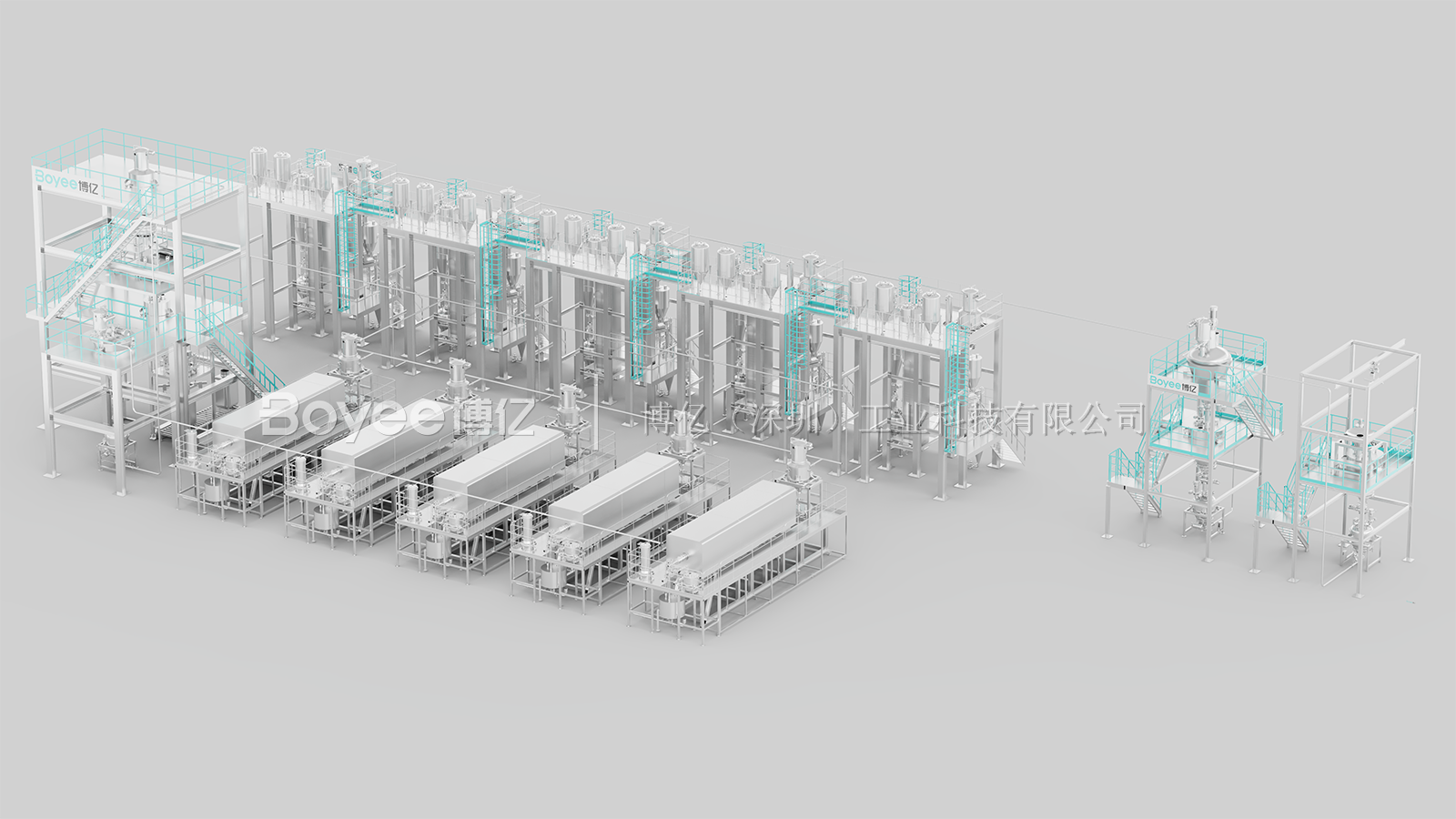
Pictured: Boyee Industrial’s CVD silicon-carbon anode production line solution
From experimental validation and pilot testing to large-scale production, Boyee Industrial provides systematic configurations centered on fluidized-bed CVD equipment, silicon-carbon anode production lines, carbon coating equipment, and fully automated production lines, offering both equipment and engineering support for the industrialization of CVD silicon-carbon anode materials.
