













LMM Centrifugal Nano Bead Mill with Screenless Separation

LMM Ultrafine Centrifugal Nano Bead Mill

Screenless Centrifugal Separation for Continuous Nano Grinding and Stable Discharge

The LMM Ultrafine Centrifugal Nano Bead Mill from Boyee is a high-performance Nano Grinding Machine designed for ultrafine wet grinding and dispersion of low-viscosity materials. Its dynamic centrifugal separation system enables efficient separation of grinding media from processed slurry without relying on a conventional discharge screen, helping reduce screen-blockage risks and maintain stable material discharge.


Unlike conventional screen-type bead mills, the LMM Centrifugal Bead Mill independently controls grinding and media separation. Selected configurations support zirconia grinding beads as small as 0.05 mm, providing a practical solution for fine particle processing and nanoscale dispersion.


The LMM series combines optional turbine or pin-type rotor systems, wear-resistant contact materials and circulating cooling technology to accommodate different material properties and grinding requirements.


With seven models covering grinding chamber volumes from 3 L to 400 L, this Ultrafine Nano Bead Mill supports laboratory process development, pilot-scale testing and industrial production. Typical applications include battery materials, electronic ceramics, conductive slurries, inkjet inks and specialty coatings.



LMM Ultrafine Centrifugal Nano Bead Mill for Battery Materials, Coatings and Inks
Equipment advantage
01

Innovative grinding system to ensure hyperfine grinding and uniform dispersion of materials

02

Centrifugal discharge method prevents material blockage, ensuring smooth continuous operation.

03

Suitable for grinding low-viscosity products, with grinding media as small as 0.05mm.

04

Unique cooling circulation system, low grinding material temperature, low energy consumption, low cost

05

All-ceramic contact chamber eliminates metal contamination.

06

High energy density rotor structure for narrow particle size distribution.

Key Advantages of the Fine Bead Mill
Clog-Free Operation

Innovative centrifugal separation replaces traditional filters, making this Centrifugal Bead Mill ideal for uninterrupted production.

Ultra-Fine Grinding Performance

Achieves nano-level particle size with excellent uniformity, making it a top-tier Ultra-Fine Bead Mill solution.

High Precision Dispersion

This Precision Sand Mill delivers consistent particle distribution for demanding industries.

Energy Efficient Design

Optimized rotor structure reduces energy consumption while improving grinding efficiency.


I. How Screenless Centrifugal Separation Works

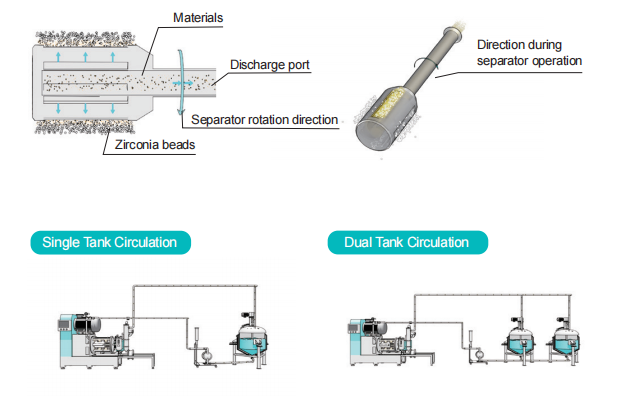
The LMM Ultrafine Centrifugal Nano Bead Mill uses a dynamic centrifugal separation system to retain grinding media while allowing processed slurry to discharge. Its screenless bead separation design reduces dependence on conventional discharge screens and supports ultrafine wet grinding of compatible low-viscosity materials.

image4.png

1. Slurry Feeding and Wet Grinding

Prepared slurry enters the grinding chamber, where the rotating grinding system transfers energy to the beads. Repeated impact and shear interactions help break down agglomerates and reduce particle size. Operating conditions are adjusted to suit the initial particle size, solids loading, viscosity and target dispersion quality.

2. Fine Zirconia Grinding Media

Selected LMM models are specified for zirconia grinding beads as small as 0.05 mm. Fine media can increase the number of grinding contacts, but the appropriate bead size depends on the equipment model, material characteristics and separation stability. A smaller bead is not automatically the best option for every slurry.

3. Dynamic Centrifugal Media Separation

The rotating separator promotes separation between grinding beads and the processed slurry. The beads remain within the milling system while slurry passes toward the discharge outlet. This differs from a conventional stationary screen design and helps reduce screen-blockage risks under suitable operating conditions.

4. Single-Tank and Dual-Tank Circulation

Single-tank circulation repeatedly transfers slurry between the processing vessel and bead mill. Dual-tank circulation uses two vessels to organize material transfer or successive process stages. The suitable layout depends on batch size, grinding objectives and production workflow.

5. Cooling and Process Temperature Control

Wet grinding generates heat during operation. The LMM cooling system helps manage process temperature and supports stable operation when configured for the slurry and duty cycle. The cooling demand should be evaluated according to material heat sensitivity, mechanical energy input and operating time.

Technical indicator
30mm-500mm

Fineness

Water/oily

Solvent system

10L-1000L/h

Capacity

≤5000CPS

Viscosity

0.05-0.2mm

Grinding medium

II. Applicable Materials & Industrial Applications

The LMM Centrifugal Bead Mill is intended primarily for compatible low-viscosity slurries requiring ultrafine wet grinding and controlled dispersion. The final equipment selection should account for chemical compatibility, material structure, contamination limits and target particle size distribution.

1. New Energy and Battery Materials

Silicon-Carbon Anode Materials: Fine processing of compatible silicon-containing and carbon-based slurries, with attention to structural sensitivity and agglomeration.

LFP and LMFP Cathode Materials: Wet grinding and dispersion for suitable cathode material processing stages. Learn more about the LFP/LMFP Production Line Solutions.

Conductive Slurries: Processing of compatible low-viscosity conductive additive slurries, subject to assessment of filler structure and shear sensitivity. Explore the Conductive Slurry Production Line Solutions.

Solid-State Electrolyte Materials: Selected materials may be considered for fine wet processing. Moisture-sensitive or chemically reactive electrolytes require dedicated solvent and environmental compatibility assessment before equipment selection.

2. Electronic Ceramics and Semiconductor Materials

Electronic Ceramics and MLCC Materials: Fine grinding and dispersion of suitable ceramic slurries where particle size distribution, abrasion and contamination control matter.

Semiconductor Material Slurries: Application suitability depends on strict particle size, contact material and cleanliness requirements. Qualification testing is necessary before use.

3. Inks, Coatings and Specialty Formulations

Inkjet and Ceramic Inks: Fine pigment dispersion to help control agglomerates and support downstream filtration and printability.

Printing Inks and Coatings: Ultrafine wet grinding of compatible low-viscosity formulations requiring controlled pigment dispersion.

Selected Pharmaceutical or Biological Formulations: Technical suitability is subject to material compatibility and any applicable cleaning, validation or regulatory requirements. Pharmaceutical-grade compliance is not assumed.

4. Material Information Needed for Evaluation

  • Initial and target particle size distribution (D50/D90, where applicable)
  • Solvent system, viscosity and solids content
  • Material temperature sensitivity and contamination limits
  • Required batch volume or production throughput
  • Preferred grinding media and equipment-contact materials
Same series of products

LMM-3L

LMM-10L

LMM-30L

LMM-60L

LMM-90L

LMM-150L

LMM-400L

LMM-3L
Equipment characteristics:

Innovative centrifugal

Material grinding and separating independent operation

suitable for low viscosity products

Gourmers can be minimal to 0.05mm

optional turbine and stick -based grinding system

more finely grinding and decentralized effects

Excellent cooling performance

Make a variety of materials meet personalized needs

Easy to operate and clean

3

Volume of grinding chamber(L)

7.5

Grinder driving power(kw)

0-1450

Decentralizer speed(r/min)

0.1-1.0

Diameter of grinding medium(mm)

800

Machine weight(kg)

1427X960X1711

Overall dimension(mm)
LMM-10L
Equipment characteristics:

Innovative centrifugal

Material grinding and separating independent operation

suitable for low viscosity products

Gourmers can be minimal to 0.05mm

optional turbine and stick -based grinding system

more finely grinding and decentralized effects

Excellent cooling performance

Make a variety of materials meet personalized needs

Easy to operate and clean

10

Volume of grinding chamber(L)

18.5

Grinder driving power(kw)

0-1460

Decentralizer speed(r/min)

0.05-1

Diameter of grinding medium(mm)

1500

Machine weight(kg)

2223X1367X1870

Overall dimension(mm)
LMM-30L
Equipment characteristics:

Innovative centrifugal

Material grinding and separating independent operation

suitable for low viscosity products

Gourmers can be minimal to 0.05mm

optional turbine and stick -based grinding system

more finely grinding and decentralized effects

Excellent cooling performance

Make a variety of materials meet personalized needs

Easy to operate and clean

30

Volume of grinding chamber(L)

45

Grinder driving power(kw)

0-1316

Decentralizer speed(r/min)

0.05-1

Diameter of grinding medium(mm)

2300

Machine weight(kg)

2924X1287X1850

Overall dimension(mm)
LMM-30L
Equipment characteristics:

Innovative centrifugal

Material grinding and separating independent operation

suitable for low viscosity products

Gourmers can be minimal to 0.05mm

optional turbine and stick -based grinding system

more finely grinding and decentralized effects

Excellent cooling performance

Make a variety of materials meet personalized needs

Easy to operate and clean

60

Volume of grinding chamber(L)

75

Grinder driving power(kw)

0-825/990

Decentralizer speed(r/min)

0.05-1

Diameter of grinding medium(mm)

2800

Machine weight(kg)

3280X1368X2240

Overall dimension(mm)
LMM-90L
Equipment characteristics:

Innovative centrifugal

Material grinding and separating independent operation

suitable for low viscosity products

Gourmers can be minimal to 0.05mm

optional turbine and stick -based grinding system

more finely grinding and decentralized effects

Excellent cooling performance

Make a variety of materials meet personalized needs

Easy to operate and clean

90

Volume of grinding chamber(L)

75-90

Grinder driving power(kw)

0-776/825

Decentralizer speed(r/min)

0.1-1

Diameter of grinding medium(mm)

3300

Machine weight(kg)

3300X1730X2140

Overall dimension(mm)
LMM-150L
Equipment characteristics:

Innovative centrifugal

Material grinding and separating independent operation

suitable for low viscosity products

Gourmers can be minimal to 0.05mm

optional turbine and stick -based grinding system

more finely grinding and decentralized effects

Excellent cooling performance

Make a variety of materials meet personalized needs

Easy to operate and clean

120-180

Volume of grinding chamber(L)

160

Grinder driving power(kw)

0-630

Decentralizer speed(r/min)

0.1-1

Diameter of grinding medium(mm)

5800

Machine weight(kg)

4500X1700X2400

Overall dimension(mm)
LMM-400L
Equipment characteristics:

Innovative centrifugal

Material grinding and separating independent operation

suitable for low viscosity products

Gourmers can be minimal to 0.05mm

optional turbine and stick -based grinding system

more finely grinding and decentralized effects

Excellent cooling performance

Make a variety of materials meet personalized needs

Easy to operate and clean

400

Volume of grinding chamber(L)

315

Grinder driving power(kw)

0-445

Decentralizer speed(r/min)

0.1-1

Diameter of grinding medium(mm)

10000

Machine weight(kg)

4600X1600X2400

Overall dimension(mm)

III. LMM Model Comparison & Selection Guide

The LMM series covers 3 L to 400 L grinding chamber volumes for process development, pilot trials and larger-scale wet grinding. Compare chamber size, reference feed rate, batch capacity and supported bead sizes before discussing a configuration with Boyee.

1. LMM Series Technical Specifications

ModelChamber Volume (L)Drive Power (kW)*Bead Diameter (mm)Batch Capacity (L)Feed Rate (L/min)
LMM-3L37.5 / 7.50.1–1.07.4–356–42
LMM-10L1018.5 / 7.50.05–1.024–1006–42
LMM-30L3045 / 7.50.05–1.062–3006–42
LMM-60L6075 / 110.05–1.0116–50025–50
LMM-90L9075–90 / 110.1–1.0173–1,00041–65
LMM-150L150160 / 150.1–1.0300–3,00066–100
LMM-400L400315–3550.1–1.0732–10,000100–300

Reference specifications from Boyee LMM technical documentation. Feed rate is not finished-product output; batch capacity differs from grinding chamber volume. Actual performance and final motor configuration are subject to project confirmation.

2. Choose by Particle Size and Slurry Properties

Define the starting particle size, target D50/D90, slurry viscosity, solid content and temperature sensitivity. These factors affect grinding media selection, rotor configuration, circulation mode and achievable processing capacity.

3. Match Grinding Media to the Specific Model

The supplied brochure lists 0.05 mm minimum bead size for LMM-10L, LMM-30L and LMM-60L, while LMM-3L, LMM-90L, LMM-150L and LMM-400L are listed with a 0.1 mm minimum. Confirm bead material and diameter for the selected model and material system.

4. Distinguish Feed Rate, Batch Capacity and Actual Output

Feed rate describes a reference slurry flow rate through the system. Batch capacity describes the processing volume in an appropriate setup. Actual finished-product output depends on circulation passes, grinding time, target fineness and formulation; it should not be inferred directly from either figure.

5. Validate Equipment Configuration Before Scale-Up

Where practical, evaluate particle size distribution, processing temperature, media wear, contact-material compatibility and repeatability through material trials. If the slurry has different viscosity or solids requirements, compare the LMM with the NMM High-Flow Screen-Type Nano Bead Mill rather than assuming one mill suits every formulation.

IV. Grinding Performance & Particle Size Evaluation

Performance evaluation for an Ultrafine Nano Bead Mill should be based on the material-specific particle size distribution and processing conditions rather than a single guaranteed fineness figure. Testing helps determine whether the proposed LMM configuration meets the target dispersion requirements.

1. Particle Size Distribution Indicators

D10, D50 and D90 describe points on the measured particle size distribution; the full curve helps reveal broad or multi-modal distributions. Test method, sample preparation and measurement basis should remain consistent when comparing feed and discharge samples.

2. Process Parameters to Record

  • Material description and starting particle size distribution
  • Grinding media material and diameter
  • Slurry solvent, viscosity and solids content
  • Mill model, rotor configuration and circulation arrangement
  • Grinding time, feed rate and processing temperature
  • Final D50/D90 and distribution curve under the stated test method

3. Interpreting Grinding Results

A smaller D50 does not by itself establish a uniformly narrow distribution. Review D90, curve shape and any secondary peaks alongside grinding time, process temperature and media wear to assess whether the result is suitable for the intended application.

Optional rotors

The LMM Centrifugal Nano Bead Mill offers turbine-type and pin-type rotor configurations to meet different grinding and dispersion requirements.

Turbine rotor

The turbine rotor promotes grinding media movement through centrifugal and shear forces, helping provide controlled and relatively gentle grinding conditions. It can be considered for materials where dispersion uniformity, particle structure protection and temperature management are important.

Pin-Type Rotor

The pin-type rotor transfers mechanical energy to grinding media through high-speed rotation and repeated impact. It can be considered for materials requiring stronger impact and shear action. The appropriate configuration depends on slurry viscosity, particle characteristics and grinding objectives.

Optional materials

Zirconia

Polyurethane (PU)

Silicon Carbide


V. Frequently Asked Questions About the LMM Centrifugal Bead Mill

These answers address common engineering and procurement questions when selecting an LMM Centrifugal Nano Bead Mill.

1. What is the advantage of screenless centrifugal separation?

The rotating centrifugal separator retains grinding media while allowing slurry discharge. It helps reduce screen-blockage risks compared with a stationary-screen discharge arrangement under suitable operating conditions.

2. What is the minimum grinding media diameter for the LMM series?

Selected models are specified for zirconia beads as small as 0.05 mm. The minimum diameter depends on the model; consult the comparison table and confirm the final media selection for your slurry.

3. Can the LMM process high-viscosity materials?

The LMM is primarily intended for low-viscosity wet grinding. Higher-viscosity or high-solids slurries require individual assessment and may be better suited to another equipment configuration.

4. Which battery materials can the LMM process?

Compatible slurry systems may include LFP, LMFP, silicon-carbon anode materials, conductive additives and selected electrolyte materials. Chemical compatibility and sensitivity to mechanical treatment must be validated.

5. How do turbine and pin-type rotors differ?

The turbine rotor can support relatively controlled media movement, while a pin-type configuration generates stronger impact and shear. The optimal rotor depends on the formulation and process objectives.

6. Is feed rate equivalent to hourly production output?

No. Feed rate is a reference slurry flow parameter. Actual output depends on the grinding target, circulation passes, process time and material formulation.

7. What information is needed for equipment selection?

Please provide the material type, starting and target particle sizes, viscosity, solids content, solvent, contamination requirements and desired batch or production capacity.

VI. Find the Right LMM Centrifugal Nano Bead Mill


Looking for Wet Grinding Equipment for ultrafine particle processing? Boyee offers LMM centrifugal nano bead mill models with different grinding chamber sizes, rotor configurations and wear-resistant contact material options.


Tell our technical team about your starting particle size, target D50/D90, slurry viscosity, solids content, solvent system and desired processing volume. We can discuss a suitable test and equipment configuration for your material.

Contact Boyee for LMM Bead Mill Selection

二维码

扫码关注