
















As lithium-ion battery technology advances toward higher energy density, silicon-carbon anodes have emerged as a promising material solution for next-generation high-performance batteries, owing to silicon's high theoretical lithium storage capacity.
However, silicon undergoes significant volume changes during charge and discharge cycles. These changes can cause particle cracking, repeated formation of the solid electrolyte interphase (SEI), and deterioration in cycling performance.
Chemical Vapor Deposition (CVD) provides an important pathway for improving the structural stability of silicon-carbon composites. By depositing nanoscale silicon within a porous carbon framework and incorporating a subsequent carbon coating process, CVD-based manufacturing can help address key challenges associated with silicon-based anode materials.
To support large-scale silicon-carbon anode manufacturing, BOYEE Industrial provides CVD silicon-carbon anode production lines and turnkey EPC solutions covering fluidized bed silane deposition, rotary furnace carbon coating, powder conveying, automated process control, and engineering project delivery.
1. CVD Silicon-Carbon Anode Production Line: Process Flow
A key objective in CVD silicon-carbon anode manufacturing is to introduce nanoscale silicon into a porous carbon framework through vapor-phase deposition, followed by carbon coating to improve the interfacial and structural stability of the composite material.
A representative BOYEE CVD silicon-carbon anode production line follows this process sequence:
Raw Material Unpacking and Feeding → Drying and Cooling → Pneumatic Conveying → Weighing and Batching → Fluidized Bed CVD Silicon Deposition → Product Discharge and Cooling → Rotary Furnace Carbon Coating → Magnetic Separation → Sieving → Weighing and Packaging
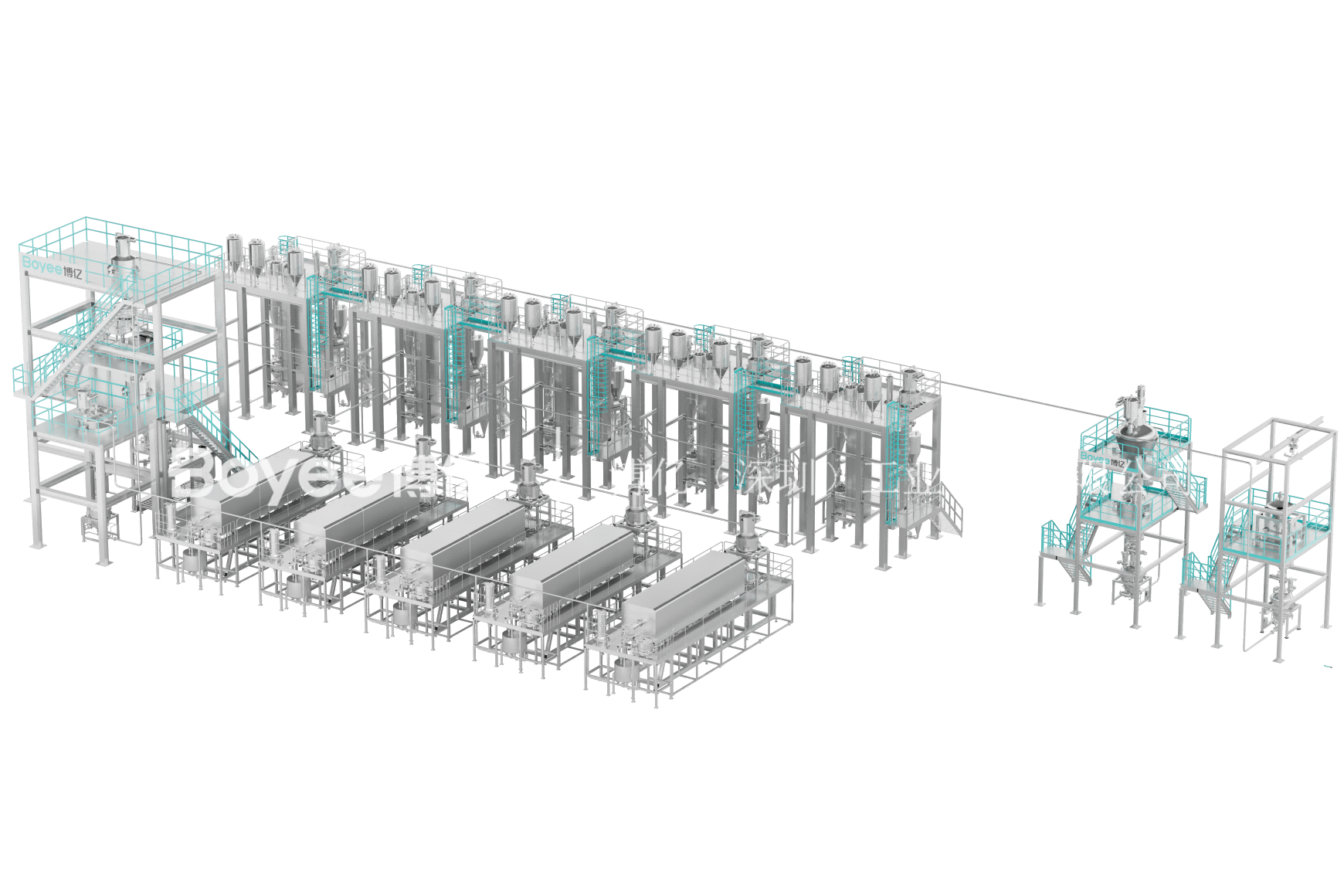
The main processing stages are outlined below.
01 | Raw Material Pretreatment and Precision Batching
Porous carbon feedstock meeting the required process specifications is introduced, dried, and conveyed to the subsequent processing stages. A metering and batching system regulates material feed to provide a stable raw material supply for silicon deposition.
02 | Fluidized Bed CVD Silicon Deposition
Porous carbon particles enter a fluidized bed reactor, where a controlled gas flow suspends and fluidizes the particles. A silicon-containing precursor gas, such as silane, comes into contact with the particles and decomposes under suitable temperature conditions.
The resulting silicon deposits within the pores and on accessible surfaces of the porous carbon particles, forming a silicon-carbon composite structure.
03 | Rotary Furnace Carbon Coating
Following silicon deposition, the material enters a rotary carbon coating furnace. As the furnace rotates, the particles are continuously turned and exposed to the carbon-source gas. Gas-phase reactions form a carbon coating layer, helping improve particle surface characteristics and interfacial stability.
04 | Powder Finishing and Packaging
The processed material undergoes cooling, conveying, magnetic separation, sieving, and weighing before packaging to complete the silicon-carbon anode powder finishing process.
The specific process parameters and equipment configuration should be matched to the pore structure of the porous carbon, target silicon content, required material properties, and production capacity.
2. Key Challenges in Scaling Up CVD Silicon-Carbon Anode Production
Moving from laboratory synthesis to industrial manufacturing requires more than achieving high material capacity. Manufacturers must also address silicon deposition uniformity, silicon loading, carbon coating consistency, and batch-to-batch reproducibility.
2.1 How Can Gas-Solid Contact Be Improved for Uniform Silicon Deposition?
During CVD reactions, temperature, gas distribution, and particle fluidization behavior all influence where and how uniformly silicon is deposited.
Poor gas distribution or excessively rapid local reactions may lead to excessive deposition on particle surfaces or pore blockage, limiting silicon penetration into the internal pore structure.
BOYEE incorporates fluidized bed reactor configurations and optimized gas distribution designs. By adjusting reaction temperature, gas flow rates, and fluidization conditions, the system supports improved contact between the silicon precursor gas and porous carbon particles, helping promote more uniform silicon deposition.
2.2 Is a Higher Silicon Content Always Better?
No. Increasing silicon loading can improve theoretical lithium storage capacity, but excessive deposition may occupy the pore volume needed to accommodate silicon expansion during lithiation and delithiation. This can increase structural stress and accelerate cycling degradation.
The balance depends on several factors, including porous carbon pore size, pore volume, silicon loading, and deposition location. These parameters must be optimized together to balance capacity and structural stability.
2.3 Why Does Carbon Coating Matter for Cycling Performance?
A carbon coating can help improve electronic conductivity, reduce direct contact between portions of the silicon surface and the electrolyte, and support the structural stability of the composite particles.
However, a thicker coating is not necessarily better. Excessive or nonuniform coating may impede lithium-ion transport and reduce the overall specific capacity of the material.
BOYEE's process configuration supports adjustment of carbon coating conditions through continuous particle tumbling in the rotary furnace, carbon-source gas delivery, and temperature control. These process variables help establish suitable coating conditions for the target material.
2.4 How Can Material Losses and Batch Variations Be Reduced?
Large-scale manufacturing requires coordinated control of raw material batching, reaction temperature, gas flow, product cooling, and powder collection.
Integrating intelligent metering, material conveying, reaction control, and collection systems helps reduce process fluctuations and provides a foundation for improving material yield and batch-to-batch consistency.
3. What Equipment Is Required for a CVD Silicon-Carbon Anode Production Line?
To meet silicon-carbon anode manufacturing requirements, BOYEE provides fluidized bed CVD equipment, rotary carbon coating furnaces, powder handling systems, and integrated production line solutions.
| Key Process | Core Equipment | Primary Function |
|---|---|---|
| Raw Material Handling | Unpacking, Feeding, Drying, and Conveying Systems | Raw material pretreatment and stable feed delivery |
| Weighing and Batching | Automated Weighing Hoppers and Batching Systems | Control of material feed rates and formulation ratios |
| Silicon Deposition | Fluidized Bed CVD Reactor | Particle fluidization, silane decomposition, and silicon deposition |
| Carbon Coating | Rotary Carbon Coating Furnace | Particle tumbling and gas-phase carbon coating |
| Cooling and Conveying | Cooling Hoppers and Pneumatic Conveying Systems | Product cooling and transfer between processing stages |
| Product Finishing | Magnetic Separation, Sieving, and Weighing and Packaging Systems | Impurity control, particle classification, and final packaging |
Among these systems, the fluidized bed CVD reactor and rotary carbon coating furnace are key equipment units in BOYEE's silicon-carbon anode process solutions.
Technical Specifications of BOYEE Fluidized Bed CVD Equipment
| Equipment Model | Discharge per Batch | Operating Temperature | Required Feedstock Particle Size |
|---|---|---|---|
| FBCVD-100 | 20 kg | ≤850°C | D50 ≥ 2 μm |
| FBCVD-500 | 100 kg | ≤700°C | D50 ≥ 3 μm |
| FBCVD-1000 | 200 kg | ≤700°C | D50 ≥ 3 μm |
| FBCVD-1500 | 300 kg | ≤700°C | D50 ≥ 3 μm |
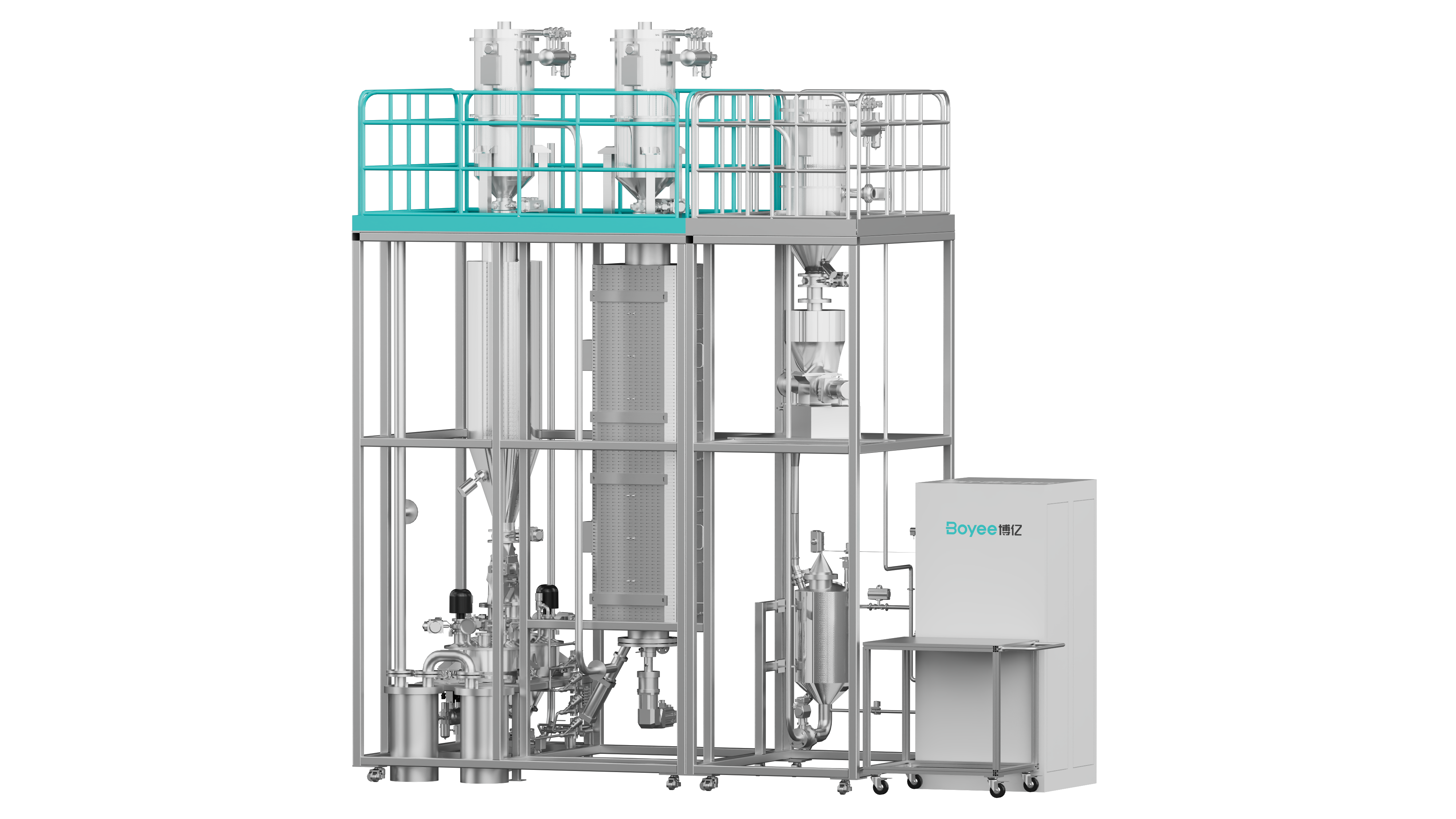
Note: The specifications above are based on BOYEE's equipment data. Discharge per batch is not equivalent to hourly production capacity. Actual throughput and product quality depend on the material system, reaction cycle, operating conditions, and process validation.
4. From Core Equipment to Turnkey EPC: BOYEE's Integrated Solutions
Scaling up CVD silicon-carbon anode production requires more than the performance of an individual reactor. Raw material handling, vapor-phase deposition, carbon coating, powder conveying, and automated control systems must work together as an integrated manufacturing process.
Drawing on its experience in intelligent equipment and integrated production line engineering for battery materials, BOYEE provides turnkey EPC solutions covering the following areas.
Process Engineering
Process routes and equipment configurations are developed according to porous carbon characteristics, target silicon loading, and production capacity requirements.
Core Equipment
BOYEE provides fluidized bed CVD silicon deposition equipment, rotary carbon coating furnaces, and associated auxiliary systems.
System Integration
Material conveying, gas supply, temperature control, cooling, and automation systems are coordinated to support integrated process operation.
Engineering and Project Delivery
The project scope can cover equipment manufacturing, installation, commissioning, and production line implementation, supporting customers from laboratory validation and pilot-scale development toward industrial manufacturing.
BOYEE continues to develop its capabilities in CVD silicon-carbon anode equipment and turnkey EPC engineering. Its experience with relevant industrialization projects supports the development of silicon-carbon anode production lines at different scales.
5. Frequently Asked Questions About CVD Silicon-Carbon Anode Production Lines
Q1: What Are the Core Processes in a CVD Silicon-Carbon Anode Production Line?
The main stages typically include porous carbon pretreatment, fluidized bed silane deposition, carbon coating, and final powder processing. Key parameters include silicon deposition uniformity, silicon loading, and carbon coating consistency.
Q2: Why Is a Fluidized Bed Reactor Used for CVD Silicon-Carbon Anode Production?
A fluidized bed uses gas flow to suspend and mobilize particles, helping improve gas-solid contact and heat transfer. This provides a process basis for silicon deposition within porous carbon structures. Actual performance depends on particle characteristics, reactor design, and operating conditions.
Q3: Why Is a Subsequent Carbon Coating Step Used in CVD Silicon-Carbon Anode Manufacturing?
A subsequent carbon coating step can help improve composite particle surface characteristics, electronic transport, and interfacial stability. Coating thickness, coverage, and uniformity must be optimized according to the target material properties.
