
















A high-speed disperser addresses this early processing stage by combining effective bulk circulation with localized shear. When properly matched to the formulation and batch size, it helps incorporate powders, distribute ingredients uniformly and prepare a consistent feed for subsequent operations.
For manufacturers of inks, coatings and adhesives, effective dispersion can improve both production throughput and batch-to-batch consistency.
From Powder Addition to Uniform Dispersion
A high-speed disperser, also referred to as a high-speed dissolver, typically uses a saw-tooth dispersing disc mounted on a rotating shaft. The disc generates strong radial flow, while circulation within the vessel returns it toward the mixing zone.
This movement continually brings fresh material into the region around the disc, where shear helps wet powders and break down agglomerates that respond to the applied shear. Adjusting the rotational speed and disc position helps accommodate changing batch conditions. Maintaining effective circulation is essential: high shear near the dispersing disc has limited value if much of the batch remains outside that zone.
Three interrelated mechanisms contribute to effective dispersion:
Wetting: Bringing the liquid phase into contact with powder surfaces.
Deagglomeration: Separating particle clusters when the applied shear is sufficient.
Distribution: Circulating the wetted solids throughout the batch.
Long-term stability also depends on the formulation, including compatible wetting agents, dispersants and rheology modifiers.
Printing Inks: Preparing a More Consistent Feed for Milling
In printing ink manufacturing, pigment wetting and incorporation affect the condition of the material entering the grinding stage. An uneven premix can contain dry pockets, coarse agglomerates or localized variations in solids concentration.
The disperser’s role should be determined by the target fineness and dispersion requirements. Some formulations may reach their dispersion target during mixing, whereas more demanding pigment systems may require subsequent bead milling. A conventional dissolver should not be expected to achieve the same particle-size reduction as a dedicated grinding mill.
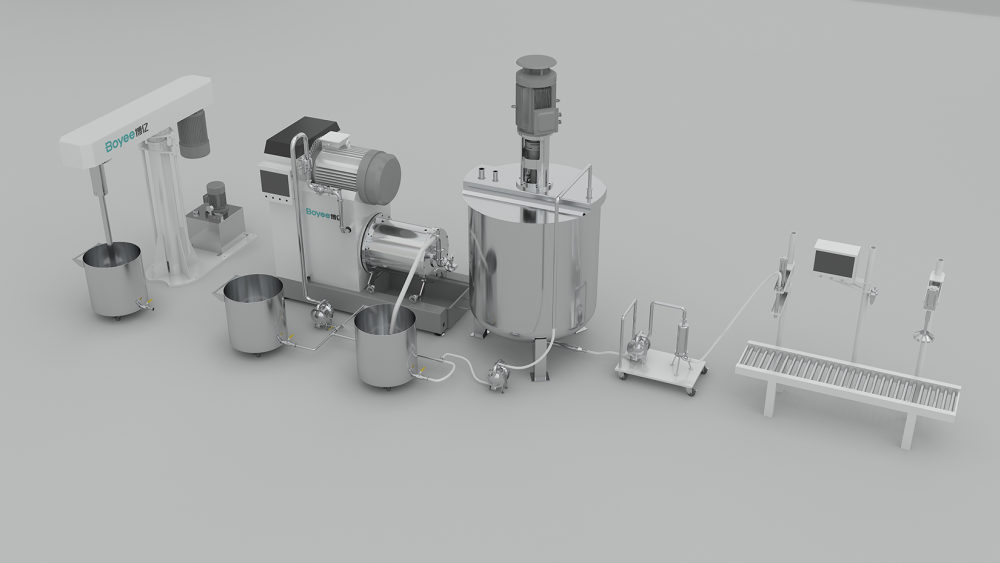
For UV ink manufacturing, Boyee’s UV ink production line solution connects dispersion and grinding with filtration, blending and filling. Defining consistent premix quality specifications helps coordinate these stages and reduce unnecessary downstream adjustments.

Paints and Coatings: Managing Pigments and Fillers Efficiently
Coating formulations often contain several solid ingredients with different wetting behavior. Pigments, mineral fillers and powdered additives may each respond differently to the same mixing conditions.
Controlled powder addition allows solids to enter the circulating liquid at a controlled rate. Adding powders faster than the liquid can wet and incorporate them may create a floating layer or lumps that require further processing.
Boyee’s intelligent production line for coatings integrates feeding, metering, mixing, grinding, filtration and filling. This enables dispersion requirements to be evaluated alongside material handling and overall line capacity.

Adhesives: Maintaining Effective Mixing as Viscosity Increases
Adhesive production may involve incorporating fillers, pigments and rheology modifiers into a resin-based or polymer-containing liquid. Uniform distribution helps support consistent processing and end-use performance.
As viscosity rises, increasing rotational speed alone may not restore effective bulk mixing. An anchor agitator, wall-scraping system or planetary mixing arrangement may be needed to move the bulk material through the active mixing region. Multi-agitator systems can combine bulk circulation with localized high-shear dispersion.
For highly viscous formulations, Boyee’s BY-MHY dual planetary mixer provides another equipment option to evaluate. Selection should account for viscosity throughout the process, rather than relying solely on the final product viscosity.
Production Efficiency Depends on More Than RPM
Disc Size and Vessel Geometry
Rotational speed must be considered together with disc diameter because together they determine tip speed. Vessel dimensions, liquid level and disc position also influence circulation. Applying the same laboratory RPM to a larger vessel does not ensure equivalent dispersion conditions.
Powder Feeding Rate
The addition rate should match the batch’s ability to wet and distribute solids. A steady, controlled feed can reduce powder accumulation and make mixing behavior more repeatable.
Temperature Control and Air Entrainment
Mechanical energy can increase the batch temperature, changing viscosity and affecting sensitive ingredients. Temperature monitoring and appropriate cooling help keep the process within its validated operating range.
Circulation should also be managed to avoid excessive air entrainment. A pronounced vortex is not automatically a sign of better dispersion; entrained air and persistent foam can complicate quality checks and downstream handling.
Batch Changeover and Equipment Utilization
Batch changeover time affects overall production capacity. Lifting arrangements and suitably designed interchangeable vessels can support flexible batch scheduling, provided cleaning and vessel handling are properly planned. These are established design options for industrial dispersers.
Matching the Disperser to the Production Task
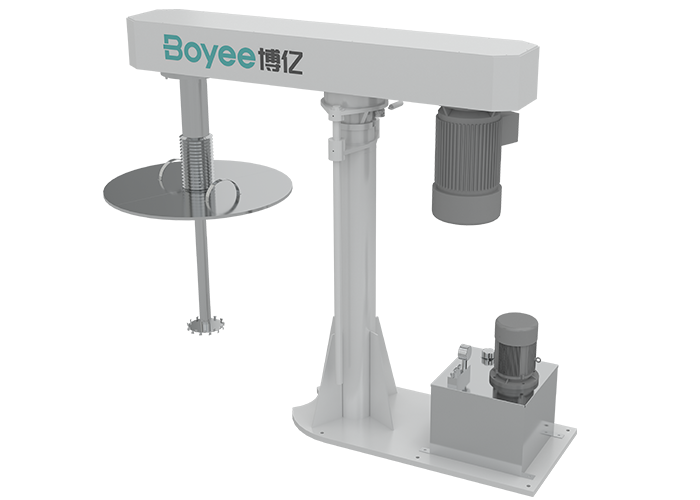
Boyee’s high-speed disperser features adjustable speed and lifting and mobile configurations for flexible operation. Vacuum-compatible and explosion-protected configurations may be available, subject to the specific material, process, and safety requirements.
When planning a new system or improving an existing line, provide the formulation type, working volume, viscosity range, powder loading, allowable processing temperature and required dispersion quality.
Contact Boyee with these details to discuss equipment selection and process integration. A representative material trial can help establish powder addition conditions, mixing settings and a realistic production cycle time.
