
















FCCVD Single-Walled Carbon Nanotube Growth Equipment: Working Principles, Key Components, and Process Flow
With the development of lithium-ion batteries, advanced composites, and flexible electronics, single-walled carbon nanotubes (SWCNTs) have attracted considerable attention as advanced nanomaterials due to their excellent electrical conductivity, high aspect ratio, and unique one-dimensional carbon structure.
However, scaling up SWCNT production from laboratory synthesis to industrial manufacturing remains challenging. Key technical requirements include continuous growth, structural control, stable product collection, and batch-to-batch consistency.
Floating Catalyst Chemical Vapor Deposition (FCCVD) provides an important technological pathway for continuous SWCNT synthesis by enabling carbon nanotube growth through gas-phase reactions involving suspended catalyst particles and carbon precursors.
This article explores the working principles, key components, critical process parameters, and integrated production solutions of BOYEE's FCCVD single-walled carbon nanotube growth equipment.
1. Working Principles of FCCVD Single-Walled Carbon Nanotube Growth Equipment
FCCVD is a chemical vapor deposition technique in which suspended catalyst particles promote carbon nanotube growth. Unlike conventional CVD processes that use stationary catalysts in certain reactor configurations, FCCVD introduces carbon sources and catalyst precursors through a gas stream, enabling continuous nanotube growth within a high-temperature reaction zone.
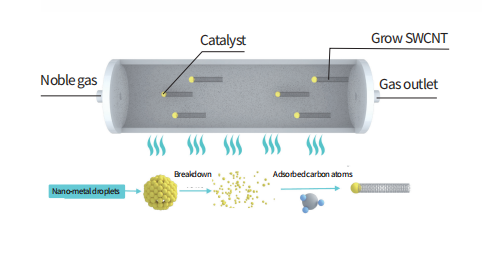
BOYEE's FCCVD equipment follows a four-stage growth process:
01 | Precise Feed Delivery
Carbon sources and catalyst precursors are introduced into the high-temperature reaction furnace at controlled feed rates and proportions to maintain a stable supply of raw materials.
02 | Catalyst Formation
The catalyst precursors decompose and nucleate under high-temperature conditions, forming suspended active catalyst particles that facilitate nanotube growth.
03 | SWCNT Growth
Carbon species generated from the decomposition of the carbon source interact with the catalyst surface, initiating nanotube nucleation and supporting continued growth.
04 | Continuous Product Collection
The resulting single-walled carbon nanotubes are carried out of the reactor by the gas stream and collected through an integrated product collection system designed for continuous operation.
Throughout the process, catalyst feed, reaction temperature, gas flow rate, and residence time must be coordinated to improve growth stability and product consistency.
2. Five Key Components of FCCVD Growth Equipment
To support continuous SWCNT synthesis, BOYEE's FCCVD equipment integrates feed delivery, heating, atmosphere control, safety protection, and continuous product collection into a coordinated system.
2.1 Multistage Ultrasonic Atomization Feed System
The multistage ultrasonic atomization system is designed to improve the uniformity of catalyst precursor delivery, providing suitable conditions for catalyst particle formation and stable nanotube growth.
2.2 Multi-Zone Heating and Temperature Control System
Depending on the equipment configuration, the system is available with five or eight heating zones. The specified temperature control accuracy is ±1°C, with temperature uniformity of ±5°C.
This multi-zone configuration supports temperature management across the reaction zone to accommodate different process requirements.
2.3 Gas Preheating and Atmosphere Control System
The equipment incorporates gas preheating and interfaces for vacuum systems. Carrier gases, reducing gases, and carbon-source gases can be configured according to process requirements, supporting atmosphere adjustment and gas purging.
2.4 Sealing, Safety Protection, and Water-Cooling Structure
The equipment features a stainless-steel enclosure and sealing structure, combined with water cooling, thermal insulation, and combustible or explosive gas detection devices. These features provide a safety protection framework for high-temperature reactions and gas handling.
The final safety configuration should be determined according to the selected equipment model, process chemistry, and applicable safety requirements.
2.5 Large-Diameter Reactor Tube and Continuous Collection System
The system uses a large-diameter reactor tube and a shaft-driven collection mechanism to support the continuous removal and collection of carbon nanotubes carried by the gas stream. This configuration is designed to reduce the need for production interruptions associated with product collection.
3. Key Process Parameters Affecting FCCVD SWCNT Growth
SWCNT structure and growth productivity are influenced by multiple process parameters that interact throughout FCCVD production.
Catalyst Precursor and Feed Rate: These affect catalyst particle formation, particle population, and catalytic activity during nanotube growth.
Reaction Temperature and Temperature Profile: These influence carbon-source decomposition, catalyst state, and SWCNT nucleation and growth.
Carrier Gas Flow Rate and Residence Time: These affect gas-phase transport, reaction conditions, and product transfer through the reactor.
Atmosphere Control and Collection Stability: These are important for continuous operation, reliable product collection, and batch-to-batch consistency.
Therefore, FCCVD process optimization should not focus solely on growth productivity. It should also consider carbon nanotube diameter, structural integrity, impurity content, and product consistency.
4. Technical Specifications of BOYEE FCCVD SWCNT Growth Equipment
To support laboratory research, pilot-scale validation, and industrial production, BOYEE provides FCCVD growth equipment with different reactor tube configurations and production capacities.
| Equipment Configuration | Heating Zones | Maximum Temperature | Approximate Growth Rate |
|---|---|---|---|
| Small-diameter single-tube configuration | 5 | 1,650°C | 6–10 g/h |
| Large-diameter single-tube configuration | 5 | 1,350°C | 30–40 g/h |
| Large-diameter dual-tube configuration | 5 | 1,350°C | 60–70 g/h |
| Extended large-diameter dual-tube configuration | 8 | 1,350°C | 100–120 g/h |
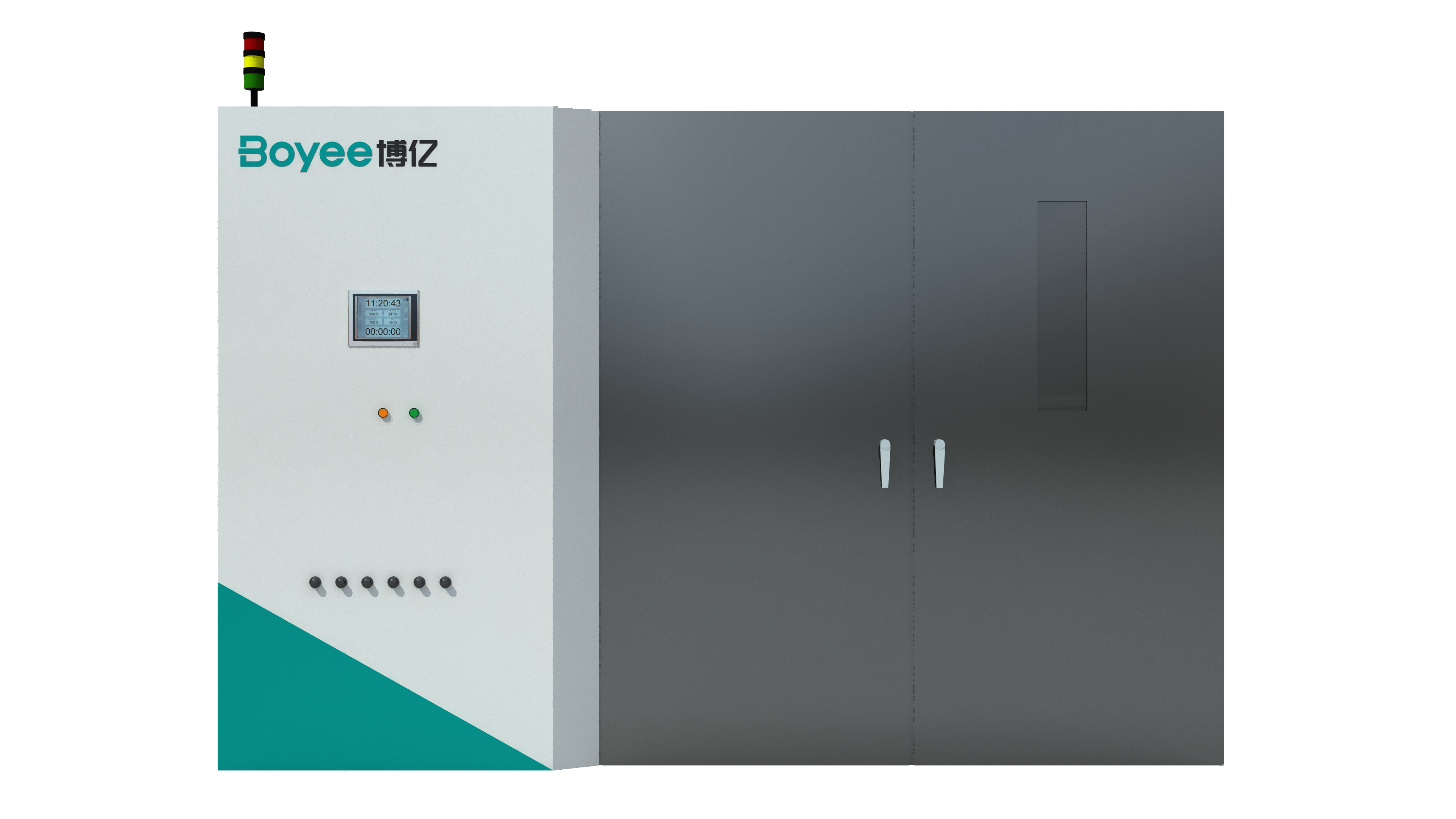
Note: The figures above are based on BOYEE's equipment specifications. Actual output and material quality depend on catalyst formulation, carbon-source selection, operating conditions, and process optimization. Final performance should be confirmed through process validation.
When selecting FCCVD equipment, customers should evaluate target material specifications, production capacity, reactor configuration, temperature control capability, continuous collection method, and safety systems as an integrated set of requirements.
5. Integrated Processing from SWCNT Powder Growth to Conductive Slurry Production
For applications such as conductive additives in lithium-ion batteries, SWCNT manufacturing involves more than powder growth. Depending on the required product specifications, downstream processing may include purification, dispersion, and conductive slurry preparation.
BOYEE provides process equipment solutions covering the following stages:
Continuous FCCVD Growth → Crude Powder Processing and Purification → High-Shear Predispersion → Homogenization and Recirculation → Finished Conductive Slurry
Predispersion and homogenization processes must balance agglomerate deagglomeration, slurry uniformity, and preservation of carbon nanotube structure. Excessive mechanical processing may shorten nanotubes or affect the formation of conductive networks, depending on the material and processing conditions.
By coordinating growth equipment with downstream dispersion systems, BOYEE supports process integration from SWCNT powder synthesis to conductive slurry production.
6. Frequently Asked Questions About FCCVD SWCNT Growth Equipment
Q1: What Is the Difference Between FCCVD and Conventional CVD?
FCCVD uses suspended catalysts in the gas phase to facilitate carbon nanotube growth, whereas some conventional CVD processes employ stationary catalysts. FCCVD offers a process pathway for continuous synthesis. Actual productivity and material quality depend on reactor design and operating conditions.
Q2: Is a Higher Growth Temperature Always Better for SWCNT Production?
No. Temperature affects catalyst behavior, carbon-source decomposition, and nanotube structure. The appropriate operating window must be established according to the catalyst system, carbon source, and target material specifications.
Q3: Can SWCNTs Produced by FCCVD Be Used Directly to Prepare Conductive Slurry?
Not necessarily. Depending on the material's purity and end-use requirements, post-treatment may be needed before predispersion and homogenization. The resulting slurry should then be evaluated for dispersion stability and electrical performance.
7. BOYEE: FCCVD SWCNT Growth Equipment and Integrated Process Solutions
Building on its expertise in nanomaterial grinding, mixing, dispersion equipment manufacturing, and system integration, BOYEE provides FCCVD single-walled carbon nanotube growth equipment and integrated solutions covering powder production through conductive slurry processing.
Through core equipment development and manufacturing, process matching, and integrated production line engineering, BOYEE supports customers at different stages of development, from laboratory validation and pilot-scale scale-up to industrial production.
From continuous SWCNT growth to conductive slurry preparation, BOYEE combines equipment engineering and process integration to support the industrialization of single-walled carbon nanotubes.
To learn more about FCCVD equipment selection, SWCNT conductive slurry processing, or integrated production line solutions, contact BOYEE Industrial to discuss your technical requirements.
